
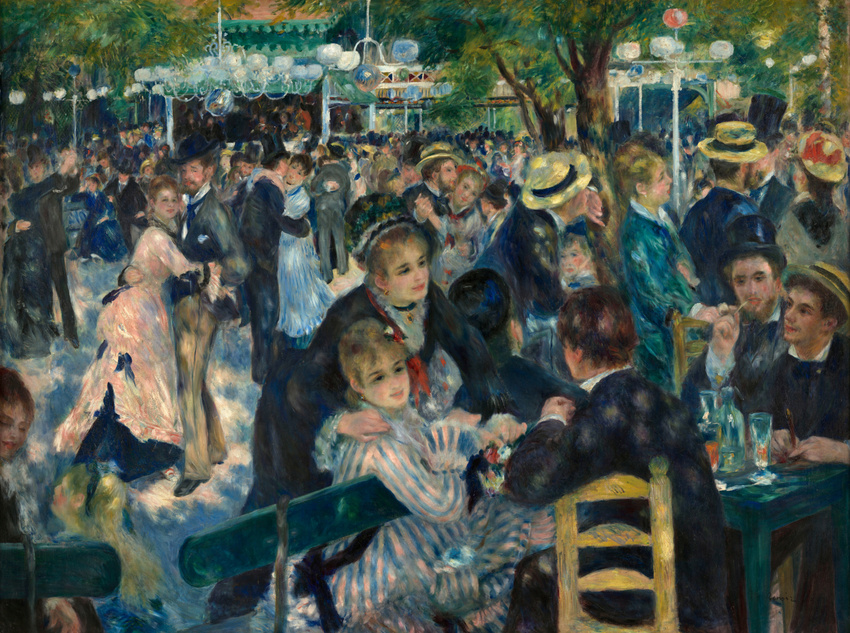
Displayed in the Musée d’Orsay in Paris, Bal du Moulin de la Galette is one of the most celebrated paintings of the Impressionist movement. Painted in 1876 by the French artist Pierre-Auguste Renoir, the work captures a lively Sunday afternoon at the Moulin de la Galette, a popular open-air dance garden in the Montmartre district of Paris. More than simply a record of a social gathering, the painting offers a vivid glimpse into everyday life in the French capital during the late 19th century.
The scene is filled with people dancing, talking, drinking and enjoying themselves beneath the trees. Sunlight filters through the leaves, creating patches of light and shadow across faces, clothing and tables. Renoir was fascinated by the challenge of capturing these fleeting effects, and much of the painting’s energy comes from the constantly shifting patterns of light that animate the crowded composition.
At the time, Montmartre was still a semi-rural area on the edge of Paris, known for its windmills, cafés and affordable entertainment. The Moulin de la Galette attracted workers, artists and members of the growing middle class who gathered there to relax and socialise. Renoir frequently visited the venue and included several friends and acquaintances among the figures in the painting. Rather than hiring professional models, he often painted people he knew, giving the scene an authentic and personal quality.
The painting reflects one of the central aims of Impressionism: portraying modern life as it was actually experienced. Instead of focusing on kings, battles or religious stories, Renoir celebrated ordinary people enjoying their leisure time. This shift toward contemporary subjects helped transform the direction of European art.
When the painting was first exhibited, some critics admired its freshness and vitality, while others dismissed the loose brushwork as unfinished. Such criticism was common for Impressionist artists, whose techniques challenged traditional expectations of polished academic painting. Over time, however, these qualities became widely admired.
Many people consider Bal du Moulin de la Galette a masterpiece because it successfully combines portraiture, landscape and social history within a single composition. The painting feels spontaneous and joyful, yet it is carefully organised to create balance and movement across the crowded scene.
For visitors exploring the Musée d’Orsay, Bal du Moulin de la Galette offers more than a beautiful image. It provides a window into the atmosphere of 19th-century Paris and demonstrates why Renoir became one of the defining artists of the Impressionist era.
https://www.musee-orsay.fr/en/artworks/bal-du-moulin-de-la-galette-497