
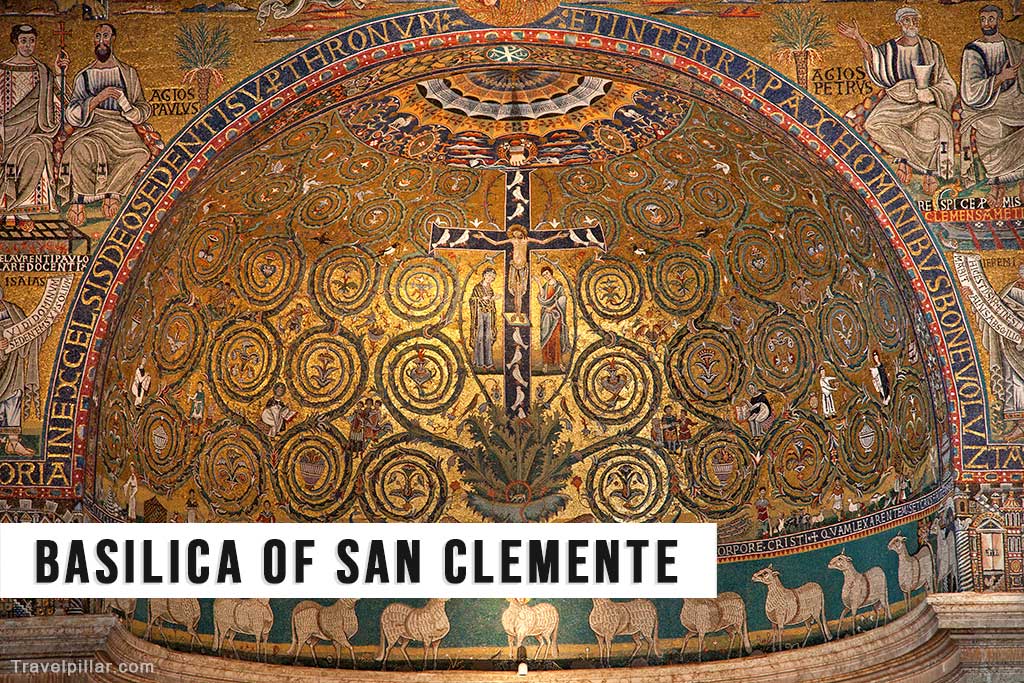
The Basilica of San Clemente is a unique and historically layered church in Rome, located near the Colosseum. It is renowned for its complex structure, which consists of three distinct architectural levels spanning different historical periods, offering a remarkable insight into the city’s Christian history and development over nearly two millennia.
The current 12th-century basilica is the uppermost level, characterized by its Romanesque architecture. The basilica’s interior features a central nave flanked by aisles separated by ancient marble columns, many of which were repurposed from earlier Roman buildings. The apse is decorated with a striking mosaic of the Cross of Christ, surrounded by intricate vine patterns and figures of saints, symbolizing the Tree of Life. The nave’s floor is adorned with a Cosmatesque mosaic, a distinctive medieval style featuring geometric patterns made from colored stones.
Beneath the 12th-century church lies a 4th-century basilica, which served as an early Christian place of worship. This earlier church, built shortly after the legalization of Christianity in the Roman Empire, contains frescoes that provide valuable insights into early Christian art and liturgical practices. Among the notable frescoes is a 9th-century depiction of the Miracle of St. Clement, illustrating the saint’s miraculous intervention in the life of a child who drowned in the Black Sea.
The lowest level of the Basilica of San Clemente reveals the remains of a 1st-century Roman building, believed to have been a private house and later a Mithraeum, a sanctuary dedicated to the cult of Mithras, a mystery religion popular among Roman soldiers. The Mithraeum contains a well-preserved altar and a fresco depicting the god Mithras slaying a bull, a central motif in Mithraic iconography.
The basilica’s multi-layered structure provides a unique archaeological narrative of Rome’s transformation from a pagan city to a center of Christianity. The San Clemente Complex is a fascinating example of how religious, social, and architectural elements have evolved and intertwined over centuries in Rome.
The Basilica of San Clemente remains an active church, offering a tranquil space for worship and reflection amid the bustling city. It is a significant destination for visitors interested in Roman history, archaeology, and early Christian art, providing a comprehensive view of the city’s religious and cultural development. The combination of historical layers, ranging from the Roman Empire to the Middle Ages, makes it a compelling site for understanding Rome’s rich and diverse past.