
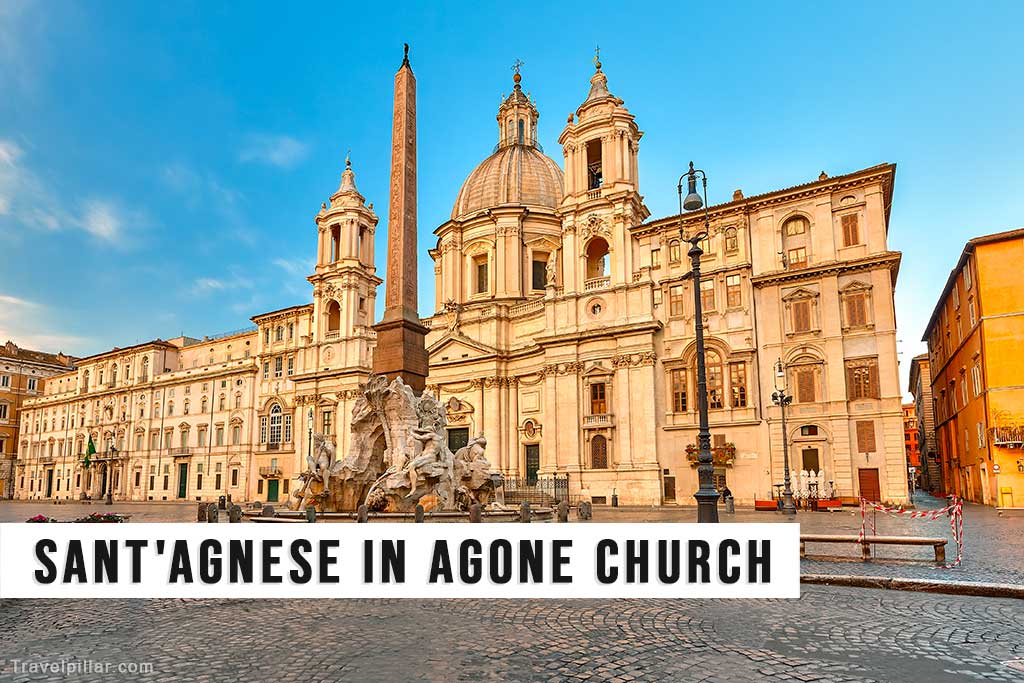
Sant’Agnese in Agone is a 17th-century Baroque church located on Piazza Navona in Rome. It was built on the traditional site of martyrdom of Saint Agnes, where, according to tradition, she was exposed naked and miraculously covered by her hair. The church’s construction began in 1652 under architect Girolamo Rainaldi and his son Carlo Rainaldi, later involving Francesco Borromini, who redesigned parts of the interior and façade.
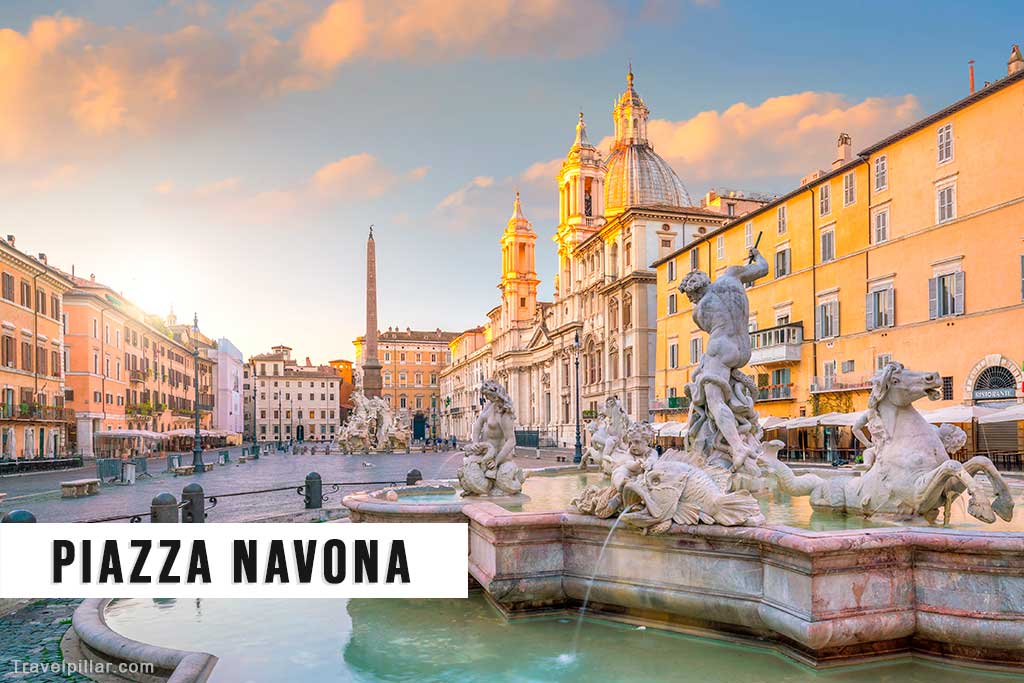
The church was commissioned by Pope Innocent X as part of his family’s architectural projects, which included the adjoining Palazzo Pamphilj (now the Brazilian Embassy). The façade faces Piazza Navona directly and is integrated into the urban setting, with concave and convex elements typical of Baroque design. Borromini’s contributions include the dome, which rises above the nave and is visible from across the piazza, enhancing the church’s prominence within the square.
The interior follows a Greek cross plan with a central dome supported by four piers. The decoration features polychrome marble, stucco work, and frescoes that emphasise the church’s rich visual character. The main altar, designed by Carlo Rainaldi, contains a relief of Saint Agnes by Ercole Ferrata, depicting her martyrdom. Beneath the church is a small chapel commemorating the site of Saint Agnes’ martyrdom, while her primary relics are housed in the Basilica di Sant’Agnese Fuori le Mura along Via Nomentana.
Sant’Agnese in Agone serves both as a parish church and as a historical monument reflecting papal patronage, Baroque architectural innovation, and the competitive atmosphere among architects in 17th-century Rome. The church’s name, “in Agone,” derives from the ancient name of Piazza Navona, “agone,” meaning contest, referring to the stadium of Domitian that once stood there.
Today, Sant’Agnese in Agone remains an active place of worship and a significant architectural landmark. It is visited for its historical associations, architectural design, and integration into Piazza Navona’s urban composition, representing the relationship between religious architecture and public space in Baroque Rome.
Official website: https://www.santagneseinagone.org/en/
Google map 4.8/5