
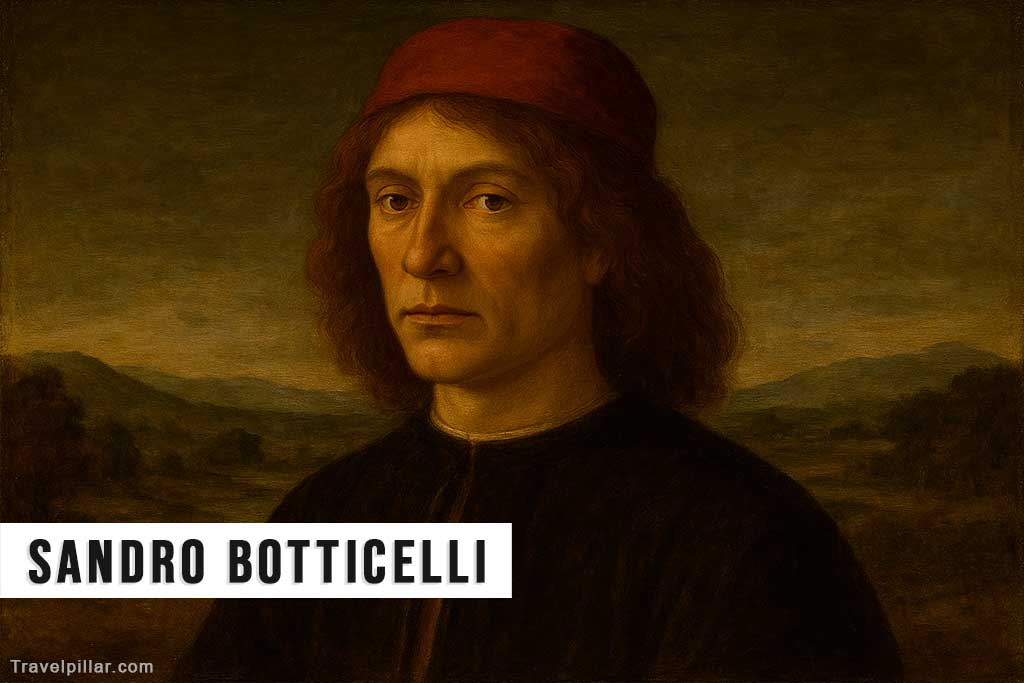
Sandro Botticelli, born Alessandro di Mariano di Vanni Filipepi (circa 1445-1510), was an Italian painter and a prominent contributor to the Early Renaissance in Florence. His works are celebrated for their linear grace, mythological narratives, and detailed allegorical content.

Botticelli was born in Florence and trained first as a goldsmith before becoming an apprentice to Fra Filippo Lippi, a leading painter in Florence. His work was further influenced by the monumentality of Masaccio’s painting and the matured artistry of Antonio Pollaiuolo.

He was patronized by the leading families of Florence, including the Medici, for whom he executed various commissions. His most famous works, “The Birth of Venus” and “Primavera,” were likely commissioned by the Medici family. These mythological paintings are characterized by their elegance, flowing lines, and the ethereal beauty of their figures. They reflect the Neoplatonic thought promoted by the Medici circle, wherein the beauty of the physical world was seen as a reflection of divine beauty.
Although Botticelli enjoyed immense popularity during his lifetime, his reputation suffered after his death, particularly with the rise of the High Renaissance style of Michelangelo and Raphael. His work was largely forgotten until the late 19th century, when there was a resurgence of interest in his paintings during the period of the Pre-Raphaelites.
Botticelli’s art embodies the spirit of the Early Renaissance in Florence with its attention to detail, exploration of linear perspective, and use of mythological and religious themes. Today, his work is appreciated for its distinctive aesthetic, narrative richness, and its representation of the cultural and philosophical preoccupations of his time. Despite the fluctuations in his posthumous reputation, Botticelli is now regarded as one of the most significant artists of the Italian Renaissance.