
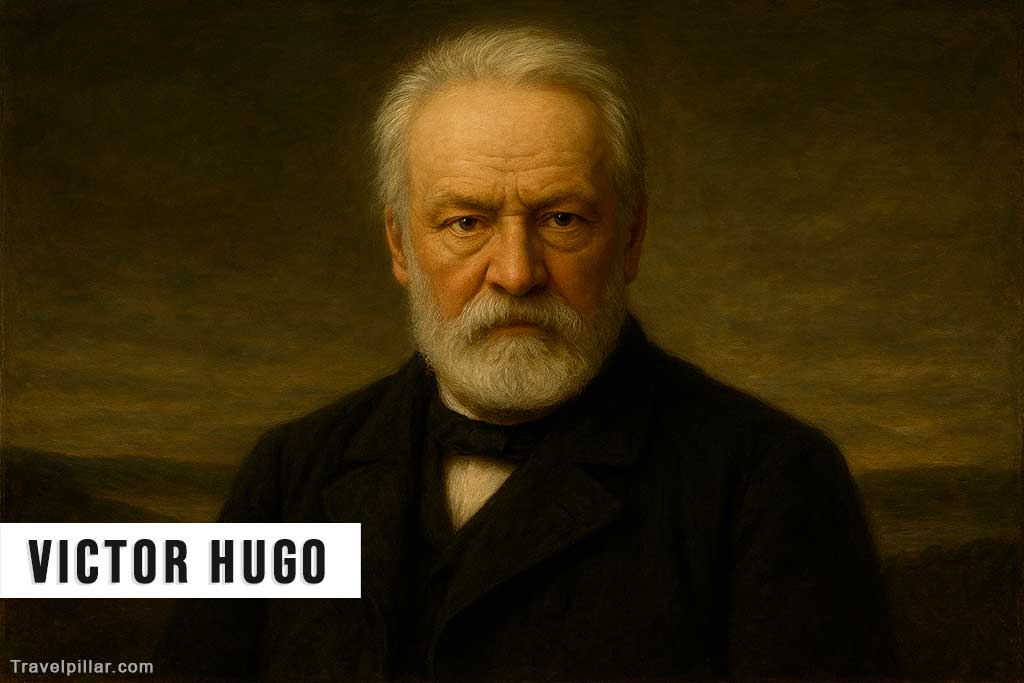
Victor Hugo (1802-1885) was a French poet, novelist, and dramatist, celebrated as one of the most significant literary figures of the 19th century. Born in Besançon, France, he began his career as a poet, establishing himself as a leading figure in the French Romantic literary movement.
Hugo’s early work, including the collections “Odes et Ballades” (1826) and “Les Orientales” (1829), demonstrated his innovative approach to verse, combining traditional and new forms to create dramatic and emotive poetry. However, it was his novels that secured his lasting fame. “Notre-Dame de Paris” (1831), known more commonly as “The Hunchback of Notre-Dame,” was an immediate success, blending a powerful narrative with social criticism and historical detail.
In 1862, Hugo published what is considered his magnum opus, “Les Misérables.” This sprawling epic focuses on the lives of several characters, most notably the reformed criminal Jean Valjean, over a period of several decades. “Les Misérables” tackles themes of social injustice, law, and grace, offering a sweeping depiction of French society during the first half of the 19th century.
In addition to his literary pursuits, Hugo was a political activist and advocate for social change. He served in France’s legislative bodies, using his platform to speak out against the death penalty and in support of free education. During the reign of Napoleon III, Hugo lived in exile on the island of Guernsey, where he wrote some of his most notable works.
Hugo’s influence on French literature is incalculable. His novels and poetry have been translated into numerous languages and continue to be widely read and studied. His vibrant characters, dramatic plots, and social critique have ensured his works’ enduring relevance and impact. The breadth and depth of his writing have cemented his place as one of the luminaries of world literature.

Sites related to his life include the Maison de Victor Hugo at Place des Vosges in Paris, where he lived for sixteen years and wrote parts of Les Misérables. He spent his later years in exile on Guernsey, where Hauteville House preserves his legacy. His remains were interred in the Panthéon in Paris, where his tomb can be visited.