
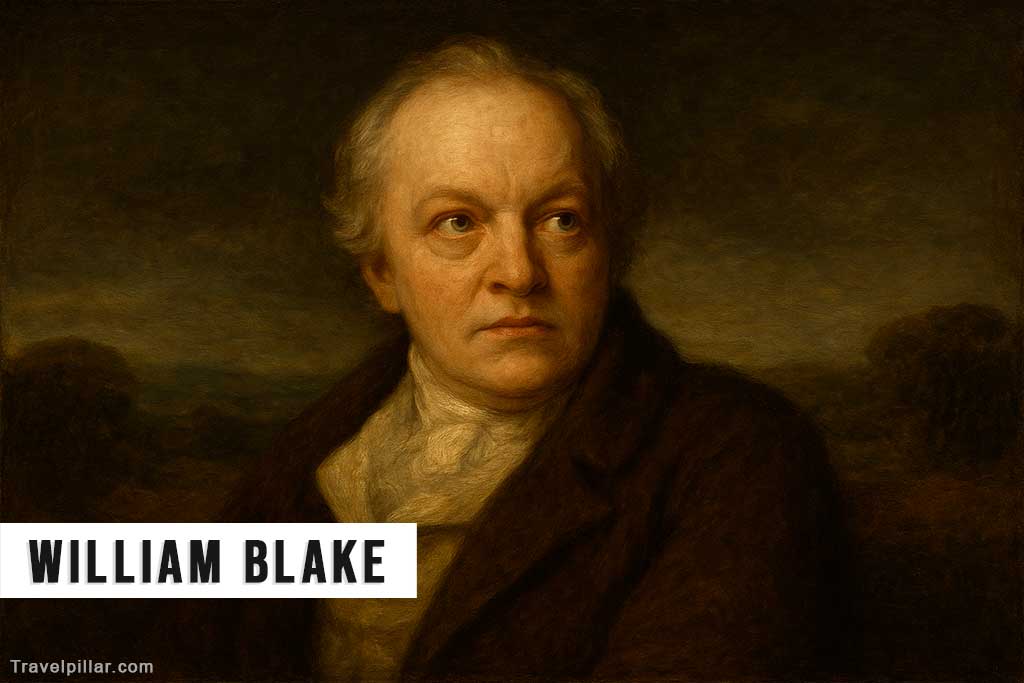
William Blake (1757-1827) was a British painter, poet, and printmaker, whose profound and symbol-laden work has left a lasting mark on the Romantic era. A visionary figure, Blake’s work encompasses a unique blend of art and literature, making him a singular presence in the canon of English arts and letters.
Blake was born in London, and showed artistic promise from a young age. His family’s modest means could only afford to send him to drawing school, but this early training nurtured his innate talent for visual art. In his early 20s, Blake was apprenticed to an engraver, which fostered his love for the medium.
In his works, Blake created a vast mythological cosmos, weaving intricate allegories that drew on both Christian and classical themes. His art often featured dramatic, spiritual scenes, laden with complex symbolism. His most noted works, such as “The Ancient of Days,” reflect his innovative approach to printmaking, where he would etch his illustrations and poetry onto the same plate.
Blake’s most significant contribution to art and literature was arguably his creation of ‘illuminated books’. These works, including titles like “Songs of Innocence and Experience,” and “The Marriage of Heaven and Hell,” combined his talents as an artist and a poet, with his evocative visual art accompanying his lyrically powerful verse.
Although Blake’s visionary art and poetry were largely overlooked during his lifetime, the 19th and 20th centuries saw a resurgence of interest in his work. Today, Blake is celebrated as a seminal figure of the Romantic Age, his unique artistic vision having inspired countless poets, painters, and musicians. His deeply symbolic, mystical works continue to intrigue scholars and art enthusiasts alike, cementing his status as a truly visionary artist.