
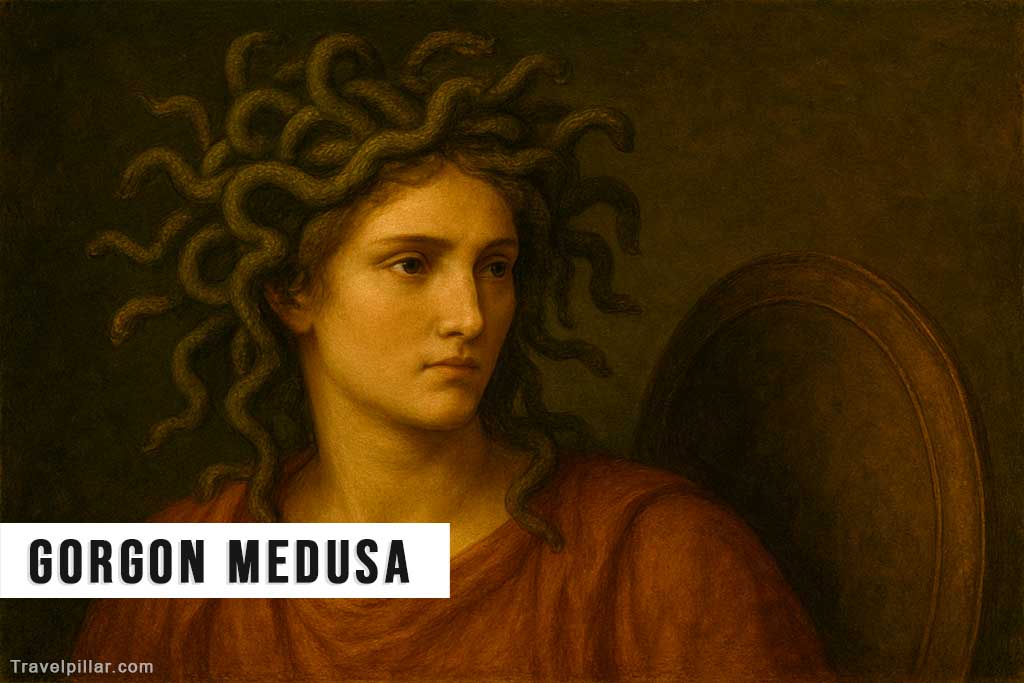
Medusa, one of the most iconic figures in Greek mythology, was a Gorgon, a monstrous being with snakes for hair. She is best known for her ability to turn anyone who looked directly at her into stone. Medusa’s myth has its origins in her transformation by the goddess Athena, who punished her for desecrating her temple. Before her transformation, Medusa was said to be a beautiful woman, but after Athena’s curse, she became a symbol of terror and despair.
Medusa was the only mortal of the three Gorgon sisters, which made her vulnerable to attack. She lived in isolation, far from human settlements, because of the deadly nature of her gaze. Her story reaches its climax when the hero Perseus, son of Zeus and Danaë, was tasked with slaying her. With the help of divine gifts from the gods, including a mirrored shield from Athena, winged sandals from Hermes, and a sword from Hephaestus, Perseus approached Medusa without looking directly at her. Using the reflective shield to see her without being turned to stone, he successfully beheaded Medusa.
Medusa’s severed head retained its deadly power and became a powerful weapon that Perseus used in later adventures. He notably used it to turn the sea monster Cetus to stone and rescue Andromeda. Ultimately, the head was given to Athena, who placed it on her shield, the Aegis, as a symbol of protection.
Medusa’s myth has been interpreted in many ways over the centuries, often symbolizing themes of transformation, power, and vengeance. Her image, though terrifying, became a popular motif in Greek art and architecture.
For travelers, Medusa’s legacy can be explored in places like Argos and Athens, where the mythological connections to Perseus and Athena remain strong. Ancient temples and ruins, such as the Acropolis, contain artistic depictions of Medusa, offering a glimpse into how ancient Greeks viewed and immortalized one of their most fascinating mythological figures.