

The Twelve Labours of Hercules are among the most famous stories in Greek mythology, detailing a series of near-impossible tasks undertaken by the hero Hercules (Heracles in Greek) as a form of penance. These labours were imposed on him by King Eurystheus of Tiryns after Hercules, in a fit of madness sent by the goddess Hera, killed his wife and children. Seeking redemption, Hercules was ordered to perform these labours, which would ultimately test his strength, endurance, and cunning.
The Twelve Labours of Hercules are:
The Nemean Lion
Hercules’ first task was to slay the Nemean Lion, a monstrous beast with impenetrable skin that terrorized the region of Nemea. Hercules strangled the lion with his bare hands and later wore its skin as armor, symbolizing his victory.
The Lernaean Hydra
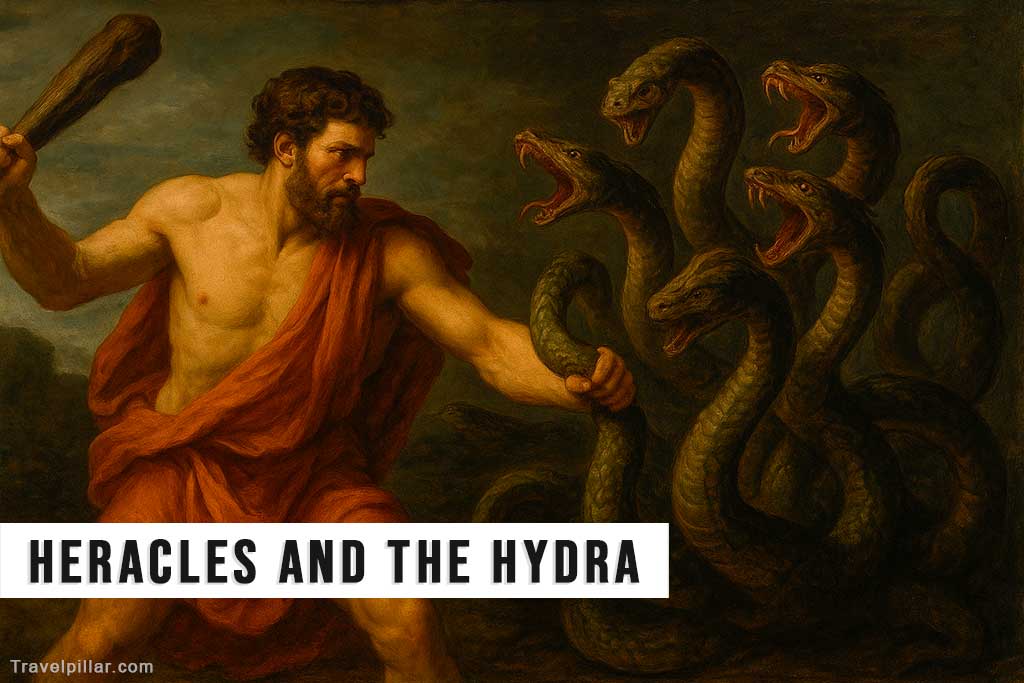
The second labour involved defeating the multi-headed Hydra, a serpent-like creature whose heads would regenerate if severed. Hercules, with the help of his nephew Iolaus, used fire to cauterize the necks of the Hydra, preventing them from growing back, and eventually defeated the beast.
The Ceryneian Hind
Hercules’ third labour was to capture the Ceryneian Hind, a sacred deer of Artemis. He pursued the hind for a year and finally captured it, carrying it back alive to Eurystheus without harming the animal, thus satisfying Artemis.
The Erymanthian Boar
The fourth task required Hercules to capture the Erymanthian Boar, a gigantic and destructive wild boar. He chased the creature into deep snow, where he managed to capture it and bring it back to the king.
The Augean Stables
Hercules was tasked with cleaning the stables of King Augeas, which had not been cleaned for decades. Using his intelligence, he diverted two rivers to wash out the stables in a single day, completing the seemingly impossible task.
The Stymphalian Birds
In his sixth labour, Hercules had to drive away a flock of dangerous, man-eating birds that resided near Lake Stymphalia. Using bronze clappers given to him by Athena, he scared the birds into the air and shot many of them with his arrows.
The Cretan Bull
Hercules’ seventh task was to capture the Cretan Bull, which had been terrorizing the island of Crete. He subdued the bull and brought it back to Eurystheus, where it was eventually released.
The Mares of Diomedes
The eighth labour involved capturing the man-eating horses of King Diomedes. After defeating Diomedes and feeding him to his own horses, Hercules tamed the animals and delivered them to Eurystheus.
The Belt of Hippolyta
For the ninth task, Hercules was sent to retrieve the belt of Hippolyta, queen of the Amazons. Although initially welcomed by the Amazons, Hera incited a battle, forcing Hercules to defeat Hippolyta and take her belt by force.
The Cattle of Geryon
Hercules’ tenth labour was to fetch the cattle of the three-bodied giant Geryon. After killing Geryon and his herdsmen, Hercules successfully herded the cattle back to Eurystheus.
The Apples of the Hesperides
The eleventh task required Hercules to retrieve the golden apples from the garden of the Hesperides, which were guarded by a dragon. With help from Atlas, who briefly held the sky in his place, Hercules obtained the apples.
The Capture of Cerberus
For the final labour, Hercules had to descend into the underworld and capture Cerberus, the three-headed guard dog of Hades. Using his strength, Hercules subdued Cerberus and brought him to the surface before returning him to the underworld.
These labours reflect Hercules’ role as both a hero and a symbol of endurance. Many ancient sites in Greece, such as the Peloponnese, are associated with Hercules’ adventures, offering travelers a chance to explore the mythological landscapes connected to his legendary feats.