
https://www.musee-orsay.fr/en/artworks/olympia-712
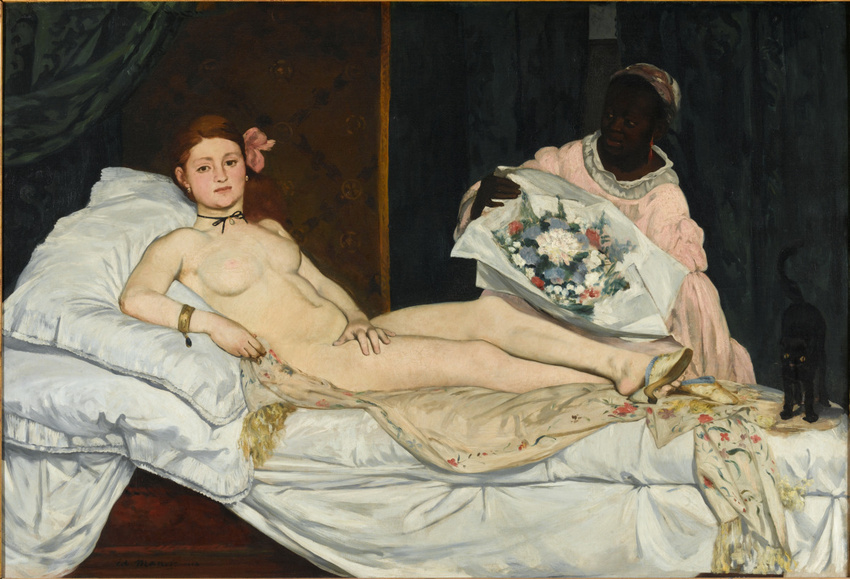
Painted in 1863, Olympia by Édouard Manet is one of the most controversial works in modern art. At first glance, it appears to follow a long tradition of reclining nudes inspired by Renaissance Venuses. However, Manet’s figure is not a distant goddess. She is a contemporary Parisian woman, widely understood to represent a prostitute, confronting the viewer with a direct and unembarrassed gaze.
The name “Olympia” was commonly used as a pseudonym by sex workers in 19th-century Paris. Unlike idealised mythological nudes, this woman wears jewellery, a ribbon around her neck and a flower in her hair — signs of fashion rather than divinity. Her servant, a Black maid, presents a bouquet of flowers, likely sent by a client. The presence of the maid reflects both colonial France and social hierarchy, contrasting sharply with Olympia’s pale, exposed body.
At the foot of the bed stands a black cat, tail raised. In traditional art, a loyal dog symbolised fidelity. Here, Manet replaces it with a cat, often associated with independence and eroticism. The message is deliberate. This is not Venus embodying eternal beauty or love. She represents a commercial, transactional relationship.
When first exhibited in 1865 at the Paris Salon, the painting provoked outrage. Viewers were not shocked by nudity itself — museums were full of it — but by the realism. Olympia does not appear idealised or submissive. She looks alert, self-possessed and economically aware. Her hand firmly covers her body, not modestly, but assertively, suggesting control rather than vulnerability.
Today, Olympia is understood as a turning point in modern art. It challenged the boundary between myth and modern life, forcing viewers to confront contemporary society instead of escaping into classical fantasy. The painting remains unsettling because its subject still meets our gaze without apology.