
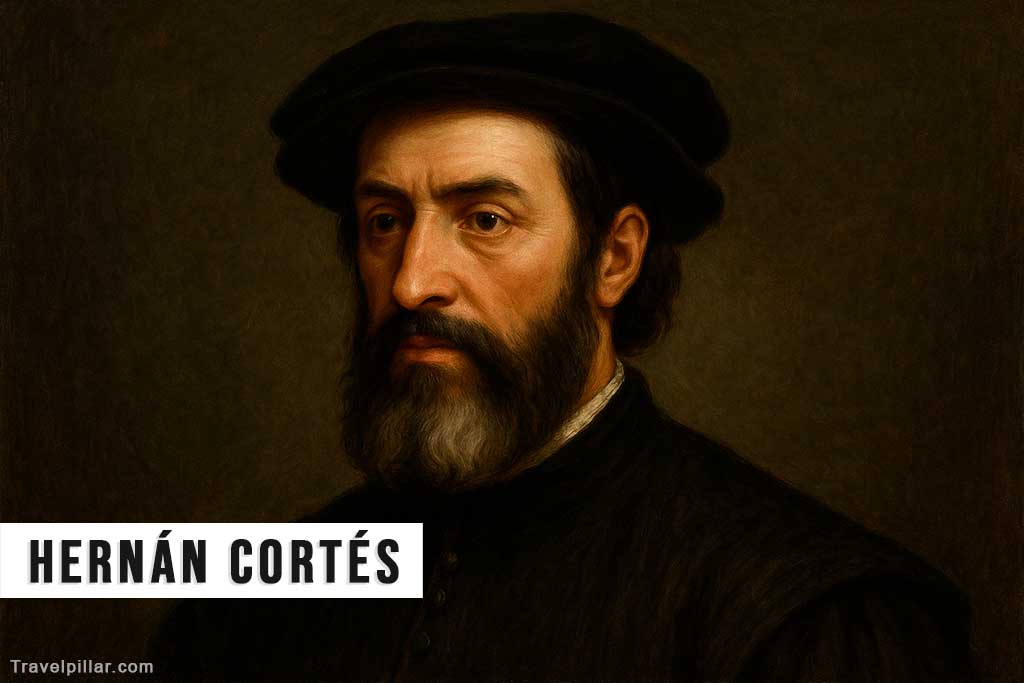
Hernán Cortés (1485-1547) was a Spanish conquistador who is primarily known for his role in the fall of the Aztec Empire, thus profoundly changing the course of history in the New World. Born in Medellín, Spain, Cortés was a law student at the University of Salamanca before he decided to seek fortune overseas.
In 1504, he traveled to Hispaniola (modern-day Dominican Republic and Haiti), where he served as a notary. His exceptional leadership skills caught the attention of Diego Velázquez, the governor of Cuba, who appointed Cortés to lead an expedition to Mexico. Defying Velázquez, who later retracted the order fearing Cortés’ ambition, the Spaniard set sail in 1519.
Reaching Mexico, he allied with some of the local tribes, who were discontented with the oppressive Aztec rule. His most significant alliance was with a Nahua woman known as La Malinche, who became his translator and advisor, and whose contributions to the campaign were pivotal. Armed with superior weaponry and tactics, and exploiting internal divisions within the Aztec Empire, Cortés managed to capture the Aztec ruler, Montezuma II, and took control of Tenochtitlan by 1521.
However, the conquering of the Aztecs was controversial due to the brutal methods employed, including warfare, enslavement, and the inadvertent spread of European diseases. The conquest caused profound demographic and cultural changes in Mexico, eroding many aspects of the indigenous civilizations and cultures, while blending them with Spanish elements.
After the conquest, Cortés became the governor of the newly-established New Spain. However, allegations of misrule led to his recall in 1528. He returned to Spain where he spent his later years, disillusioned and embittered.
Cortés’ legacy remains a contentious issue. While some view him as a bold explorer, others see him as a symbol of destruction and colonial exploitation. Despite the controversies, his influence on the cultural, political, and demographic landscape of Mexico is undeniable and enduring.