
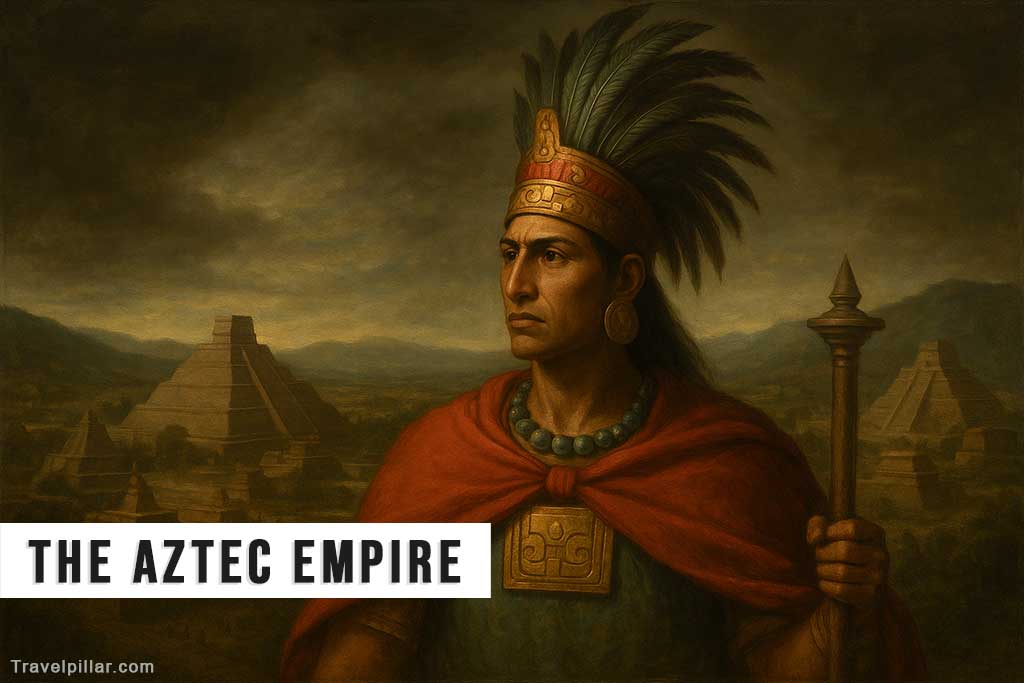
The Aztec Empire was a powerful Mesoamerican civilization that dominated central Mexico from the early 15th century until the Spanish conquest in 1521. Known for its military strength, advanced social organization, and impressive architecture, the empire played a crucial role in shaping the cultural and historical landscape of pre-Columbian America.
The Aztec people, originally a nomadic tribe, settled in the Valley of Mexico around the early 1300s. They founded their capital city, Tenochtitlán, on an island in Lake Texcoco in 1325. This location would become the heart of their empire. The Aztecs formed a complex society with a hierarchical structure, where the emperor, known as the “Tlatoani,” ruled over a multi-ethnic population. Below the emperor were nobles, priests, warriors, merchants, and commoners, each with specific roles within the society.
The empire expanded rapidly through a combination of military conquest and alliances. By the height of its power in the early 16th century, the Aztec Empire controlled large portions of central and southern Mexico, ruling over millions of people. Its influence extended to various regions, enforcing tribute from conquered peoples and incorporating their resources and labor into the empire’s economy.
Religion was a central aspect of Aztec life. The Aztecs worshiped a pantheon of gods, the most important of whom was Huitzilopochtli, the god of the sun and war. Human sacrifice, often of captured enemies, was a significant part of their religious practices, believed to appease the gods and ensure the continuation of the world. This aspect of their culture was one of the many features that both fascinated and horrified the Spanish conquistadors.
Tenochtitlán, the capital, was an architectural marvel for its time. The city featured grand temples, including the Templo Mayor, a double pyramid dedicated to Huitzilopochtli and Tlaloc, the rain god. The city’s urban planning included canals, causeways, and aqueducts that supported a population estimated to be over 200,000 people. It was one of the largest and most sophisticated cities in the world at the time.

The empire’s decline began with the arrival of Spanish conquistadors led by Hernán Cortés in 1519. Allied with indigenous groups that were hostile to the Aztecs, the Spanish launched a campaign that culminated in the fall of Tenochtitlán in 1521. Diseases brought by the Europeans, such as smallpox, further weakened the population, leading to the collapse of the Aztec Empire.
Today, the legacy of the Aztec Empire can be seen in Mexico City, which was built on the ruins of Tenochtitlán. Visitors to the city can explore the remains of the Templo Mayor and other archaeological sites, offering insights into the rich and complex history of the Aztec civilization.
Google map Templo Mayor de México-Tenochtitlan 4.8/5
Google map Templo Mayor Museum 4.8/5