
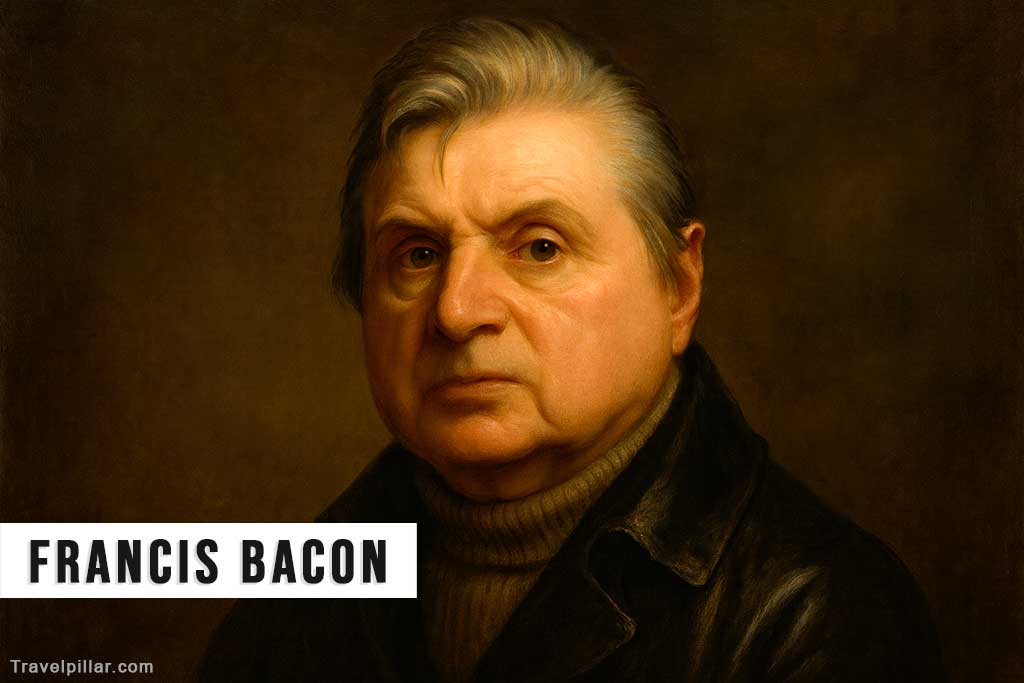
Francis Bacon (1909-1992) was a British painter recognized for his bold, grotesque, emotionally charged, and raw imagery. He is best known for his depictions of people in distorted and abstract forms, often confined within geometric structures.
Born in Dublin, Ireland to English parents, Bacon was largely self-taught as an artist. He began painting in the 1930s but only garnered significant attention in 1944, with his triptych “Three Studies for Figures at the Base of a Crucifixion.” His work is characterized by its exploration of existential angst, isolation, and the human condition.
Bacon’s style is marked by a unique ability to convey emotion through image. His figurative paintings, often featuring a single person in a room, exude an intense psychological charge. A sense of tension and unease permeates his work, with his distorted figures trapped in claustrophobic, geometric spaces.
Bacon drew inspiration from a wide range of sources, including the works of Old Masters like Diego Velázquez and Rembrandt, photographic stills, and sequences from films. These influences, coupled with his own turbulent personal life and his ruminations on the human condition, resulted in a body of work that is both deeply personal and universally resonant.
One of his most iconic works is “Study after Velázquez’s Portrait of Pope Innocent X,” a series of paintings wherein he reinterprets Velázquez’s masterpiece with his characteristic distortions and intense coloration, creating a powerful sense of anguish.
Francis Bacon’s art was controversial and met with mixed reactions throughout his career. Today, however, he is regarded as a crucial figure of 20th-century art, his work admired for its visceral impact and exploration of the complexities of human existence. Bacon’s legacy as an artist lies in his ability to confront the viewer with the emotional intensity and existential fear embodied in his paintings.