
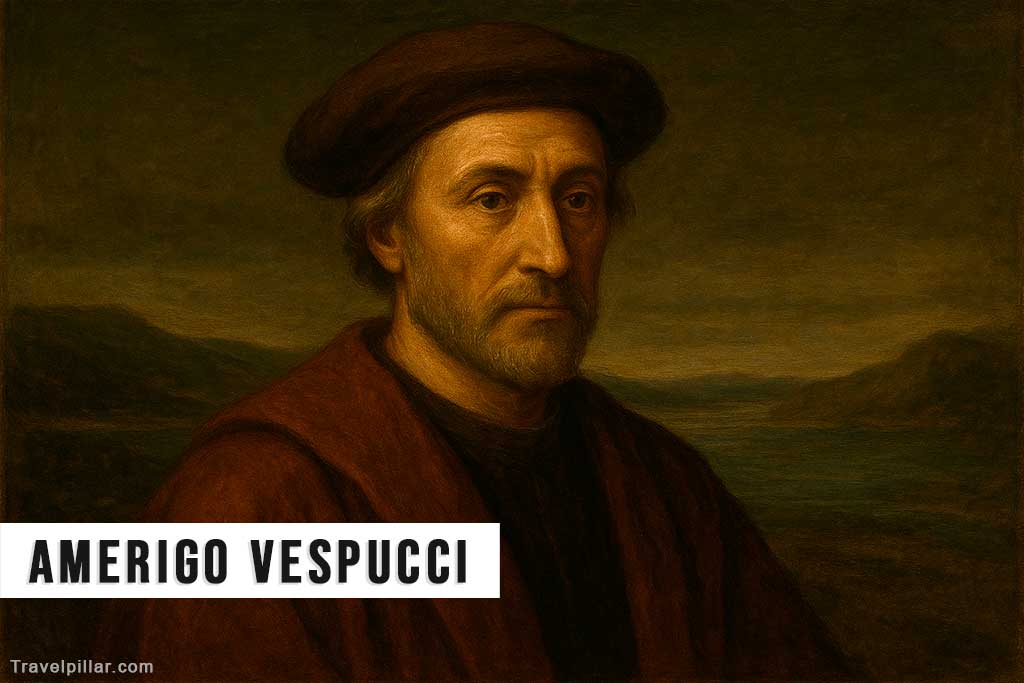
Amerigo Vespucci (1451-1512) was an Italian merchant, explorer, and navigator from whom the Americas take their name. Born in Florence, Vespucci was part of a prominent family and received a scholarly education. After working for the Medicis, a powerful banking family, Vespucci moved to Seville, Spain, in 1492, where he entered the service of a company that equipped voyages to the New World.
Though Vespucci’s voyages are debated by scholars due to inconsistencies and ambiguities in his written accounts, it is generally accepted that he undertook at least two significant voyages. The first was in 1499-1500, in which he explored the coast of South America, and the second in 1501-1502, where he explored Brazil’s eastern coast. It is on these voyages that Vespucci suggested that the lands discovered by Christopher Columbus were not part of Asia, as initially thought, but a separate continent, a “New World.”
It was this insight that led to Vespucci’s lasting legacy. Amerigo Vespucci wrote letters describing his travels and observations, and his accounts were widely circulated in Europe. A Latin version of his most famous letter, titled “Mundus Novus” (New World), was published in 1503-04 and spread his assertion that the lands discovered were a new continent. Consequently, the German cartographer Martin Waldseemüller, in his world map of 1507, labelled the new continent as “America” in Vespucci’s honor.
Despite his contributions, Vespucci’s reputation has been tarnished by allegations that he exaggerated his achievements and downplayed those of Columbus. However, there is no denying his significant role in the Age of Exploration. The term “America” stands as a testament to Vespucci’s contribution to understanding the geographical realities of the New World, and his narratives have enriched our knowledge of early exploration of the Americas.