

The Van Gogh Museum houses the largest collection of works by Vincent van Gogh, comprising more than 200 paintings, 500 drawings, and approximately 700 letters. The museum offers a chronological presentation of Van Gogh’s artistic development, beginning with his early works in the Netherlands and progressing through his time in Paris, Arles, Saint-Rémy, and Auvers-sur-Oise. Notable paintings include Sunflowers, The Bedroom, Almond Blossom, and The Potato Eaters. The exhibition highlights Van Gogh’s evolving use of colour, brushwork, and subject matter, while also documenting his personal struggles and correspondence with his brother Theo.

The museum includes works by Van Gogh’s contemporaries, such as Paul Gauguin, Claude Monet, Émile Bernard, and Henri de Toulouse-Lautrec, placing Van Gogh’s output in the broader context of late 19th-century art. The collection is housed in a modernist building designed by Gerrit Rietveld, with a later wing added by Kisho Kurokawa.
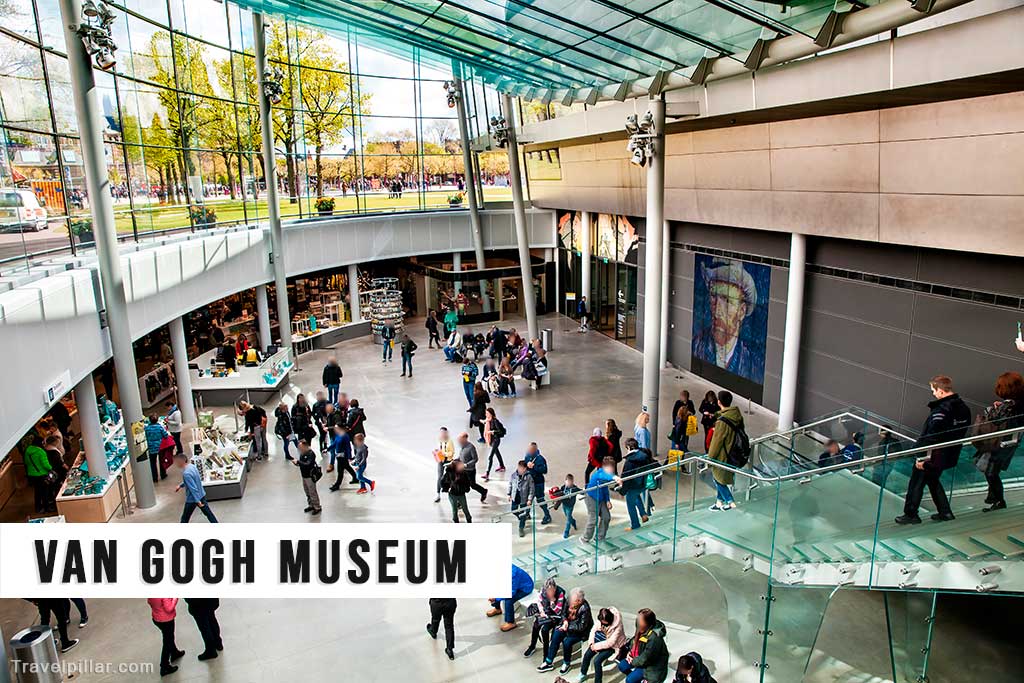
In addition to permanent displays, the museum hosts temporary exhibitions focused on Van Gogh’s influence and related art historical themes. It also functions as a research centre dedicated to the study and conservation of Van Gogh’s work. The museum attracts millions of visitors annually and is a major centre for post-Impressionist art scholarship.
Official website: https://www.vangoghmuseum.nl/en
Google map 4.6/5
Van Gogh Museum Highlights
Here are some highlights of the Van Gogh Museum’s collection:
“Sunflowers” (1889)
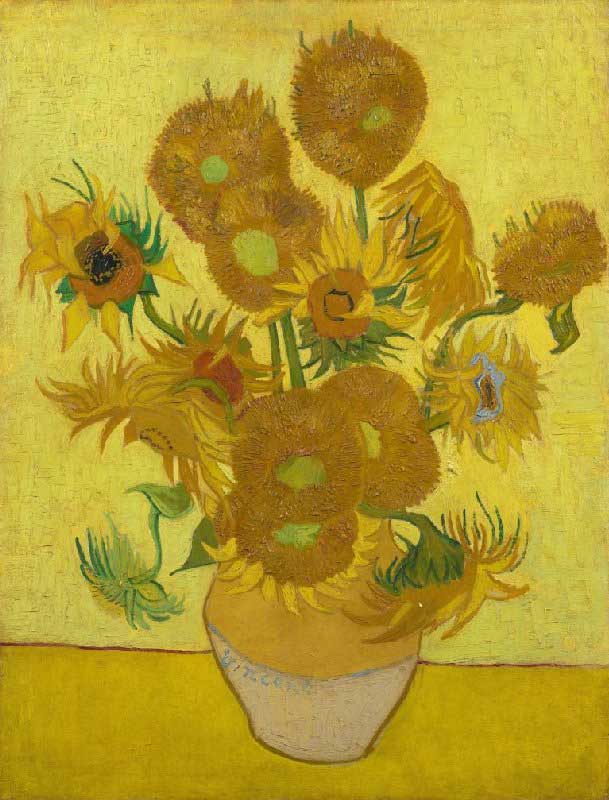
Sunflowers (1889) is part of a series depicting sunflower arrangements in a simple vase, rendered in vivid yellows and ochres. The painting explores variations in form, texture, and decay, using thick brushstrokes and strong contrasts. Intended to decorate a guest room, the composition reflects an interest in symbolic colour and expressive technique. It illustrates a shift toward brighter palettes and is associated with the artist’s optimism during his time in the south of France.
https://www.vangoghmuseum.nl/en/collection/
“The Bedroom” (1888)

*The Bedroom* (1888) depicts Van Gogh’s own bedroom in Arles, France, and is known for its bold use of colour and perspective. The painting shows a simple interior with a bed, chairs, and basic furnishings, arranged in a skewed perspective that flattens space. Strong outlines and contrasting tones of blue, yellow, and red contribute to a sense of calm and order. The work reflects a personal moment of stability and a desire for rest.
https://www.vangoghmuseum.nl/en/collection/
“Almond Blossom” (1890)
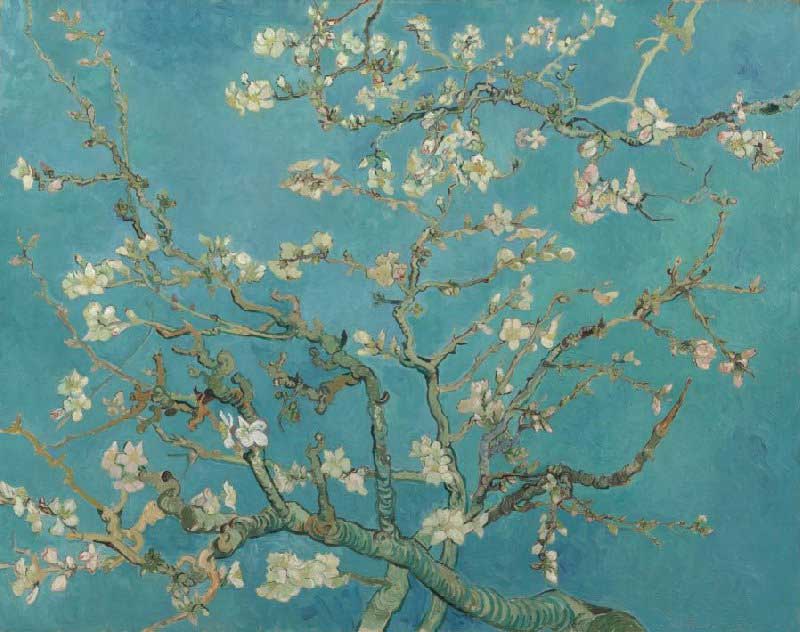
Almond Blossom (1890) was painted to celebrate the birth of Van Gogh’s nephew and symbolises new life and hope. It shows delicate white blossoms set against a bright blue sky, influenced by Japanese prints. The branches are seen from below, giving a sense of openness and light. The composition is simple but carefully arranged, using strong outlines and contrasting colours to create a calm, uplifting image focused on renewal and beauty in nature.
https://www.vangoghmuseum.nl/en/collection/
“Irises” (1890)

Irises (1890) shows a group of purple irises set against a background of green leaves and pale earth. Painted while Van Gogh was staying at an asylum, the work reflects his focus on nature and the calming effect of close observation. The flowers are outlined with dark contours, giving them definition and structure. The composition is balanced and clear, with attention to pattern, rhythm, and the contrasting shapes of leaves and petals.
https://www.vangoghmuseum.nl/en/collection/
“Self-Portrait as a Painter” (1887–1888)

Self-Portrait as a Painter (1887–1888) shows the artist holding a palette and brushes in front of a canvas, affirming his identity and commitment to painting. Created during his final months in Paris, the work reflects his exposure to Impressionist and Neo-Impressionist techniques. The loose brushwork and muted colours demonstrate his evolving style. It is one of his last self-portraits before moving to Arles, marking a transitional phase in his artistic development.
https://www.vangoghmuseum.nl/en/collection/
“Wheatfield with Crows” (1890)
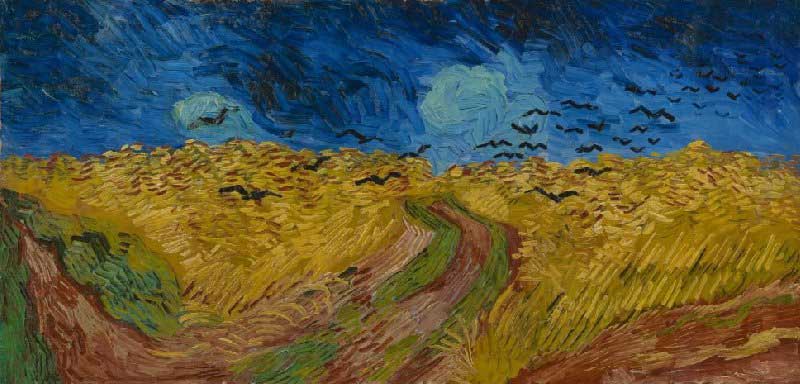
Wheatfield with Crows (1890) depicts a broad wheat field under a turbulent sky, intersected by dark paths and scattered with crows. Painted during Van Gogh’s final weeks, the work is often interpreted as reflecting psychological tension, though no direct evidence confirms this. The heavy brushwork and strong contrasts suggest emotional intensity. It is one of several late landscapes focused on the countryside near Auvers-sur-Oise, where he spent his last months.
https://www.vangoghmuseum.nl/en/collection/
“Wheatfield with a Reaper” (1889)

Wheatfield with a Reaper (1889) shows a figure cutting wheat under a bright sun, set within a wide, undulating field. Painted while Van Gogh was in an asylum at Saint-Rémy, the work reflects his view from the hospital window. The reaper is portrayed not as threatening but as part of the natural cycle of life and death. The simplified forms and strong colour contrasts demonstrate Van Gogh’s interest in symbolic and expressive landscape painting.
https://www.vangoghmuseum.nl/en/collection/
“The Yellow House” (1888)
The Yellow House (1888) depicts the building in Arles where Van Gogh lived and hoped to establish an artists’ community. The painting shows the house from the street, with bright yellow walls contrasting against a blue sky. It includes the surrounding buildings, railway tracks, and figures, offering a view of his everyday environment. The work reflects Van Gogh’s optimism during this period and his efforts to create a stable and collaborative artistic space.
https://www.vangoghmuseum.nl/en/collection/
“The Sower” (1888)

The Sower (1888) shows a figure scattering seed across a field beneath a setting sun. Painted in Arles, the composition reflects Van Gogh’s interest in rural labour and symbolic themes of growth and renewal. Influenced by Jean-François Millet, the painting uses strong outlines and contrasting colours, particularly yellows and violets. The work combines observation with personal symbolism, portraying the sower as a timeless figure within the natural cycle of life and death.
https://www.vangoghmuseum.nl/en/collection/
“Tree Roots” (1890)

Tree Roots (1890) is a dense, abstract composition of tangled roots and vegetation, painted in Auvers-sur-Oise shortly before Van Gogh’s death. The subject is ambiguous, with no clear horizon or spatial depth, focusing instead on colour, texture, and form. The work demonstrates a shift toward abstraction, with expressive brushwork and bold contrasts. Often considered Van Gogh’s final painting, it reflects his continued experimentation and interest in natural complexity and structure.
https://www.vangoghmuseum.nl/en/collection/
“Head of a Skeleton with a Burning Cigarette” (1886)

Head
https://www.vangoghmuseum.nl/en/collection/
“Self-Portrait with Grey Felt Hat” (1887)
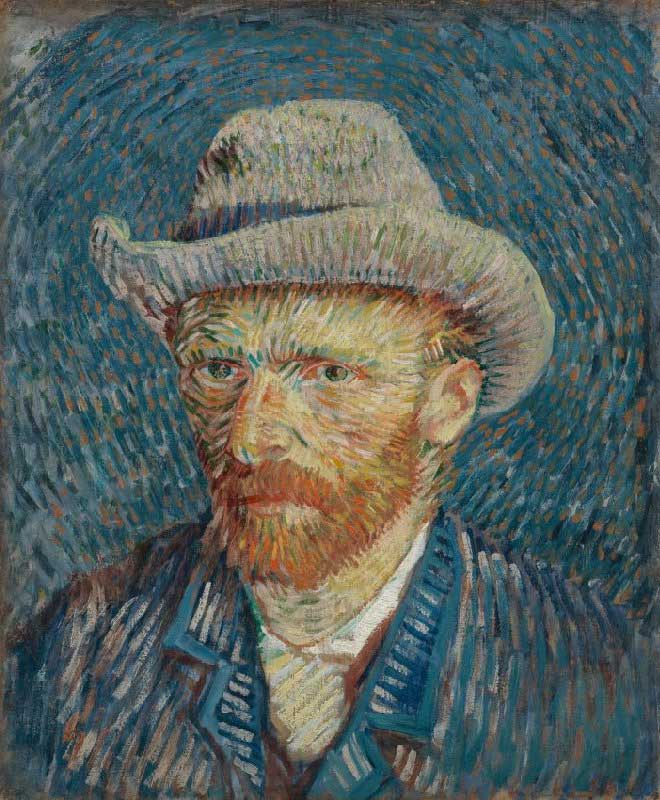
Self
https://www.vangoghmuseum.nl/en/collection/
“The Potato Eaters” (1885)

The Potato Eaters (1885) depicts a peasant family gathered around a dimly lit table, sharing a modest meal. The composition emphasises coarse features, rough textures, and dark tones to reflect the harshness of rural life. Influenced by Dutch genre painting and social realism, the work aims to portray dignity in poverty. It marks an early stage in the artist’s development, focusing on human labour, simplicity, and the authenticity of working-class existence.
https://www.vangoghmuseum.nl/en/collection/
Related Post:
Best Museums in the World

Museums preserve the artistic, scientific and cultural achievements of civilisation. The institutions listed below contain some of the world’s most important collections, ranging from ancient archaeology and Renaissance painting to modern art, natural history and science.
This ranking is inevitably subjective, but the museums below stand out for the scale of their collections, the quality of their exhibitions, their historical importance and the overall visitor experience. Click on the museum name or image to explore each museum in more detail.