
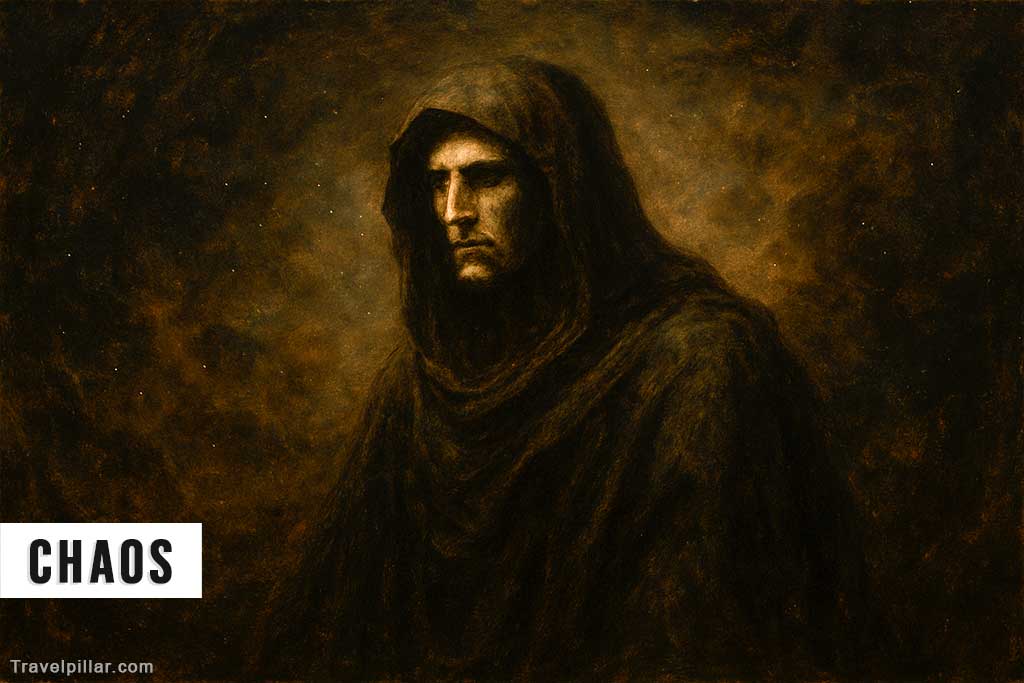
Chaos, in Greek mythology, is the primordial void that existed before the creation of the universe. It represents a formless, empty space from which all existence began. As one of the earliest elements in Greek cosmogony, Chaos is not a deity with a defined personality or form but rather a concept that embodies the absence of order and structure. From Chaos, the first primordial beings emerged, initiating the process of creation that led to the formation of the world and the gods.
According to the ancient Greek poet Hesiod in his Theogony, Chaos was the first entity to exist, followed by Gaia (Earth), Tartarus (the Abyss), and Eros (Love). These beings, born from Chaos, represent the foundational forces of the universe. Gaia personified the Earth, providing a solid ground for life, while Tartarus symbolized the underworld, a deep chasm where the Titans would later be imprisoned. Eros, as the force of attraction, played a crucial role in bringing together these elements, leading to the birth of other gods, Titans, and mortals.
Chaos is a central figure in Greek mythology’s understanding of the universe’s origins. It emphasizes the Greek conception of the cosmos as emerging from a state of disorder into a structured world ruled by the gods. Over time, the offspring of Chaos shaped the world, from the natural elements to the divine hierarchy that dominated ancient Greek religion.
Although Chaos is not associated with specific temples or worship, its significance lies in its role as the foundation of all existence in Greek mythology. The concept of Chaos as the origin of everything influenced Greek philosophy and later interpretations of the universe’s creation.
For travelers interested in exploring ancient Greek mythology, visiting sites such as the Acropolis in Athens or the Oracle of Delphi can offer insights into the mythology and religious practices that were shaped by these ancient beliefs, including the concept of Chaos as the starting point of creation. These locations provide a connection to the rich mythological traditions that continue to inspire modern culture.