
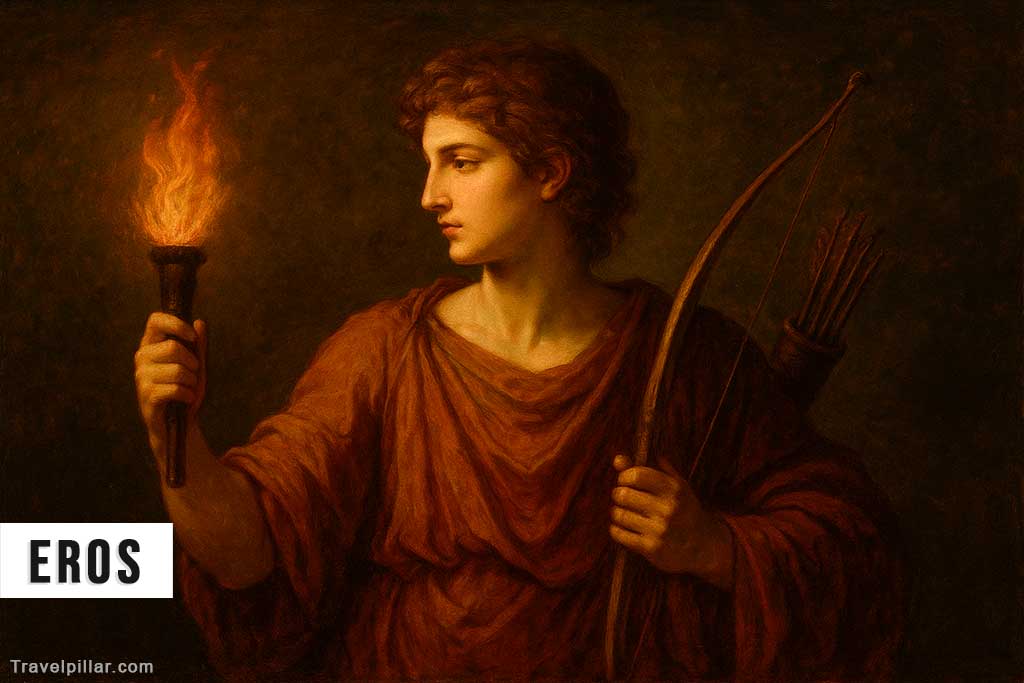
Eros, in Greek mythology, is the god of love and desire, playing a central role in the creation and harmony of the universe. Eros is often portrayed in two different forms across myths: as a primordial deity who emerged from Chaos, representing the fundamental force of attraction and creation, and as the mischievous son of Aphrodite, the goddess of love, and Ares, the god of war.
In the earliest myths, Eros is one of the primordial deities, a force essential to the cosmos, bringing order from Chaos by facilitating the union of elements and the birth of life. He symbolizes the irresistible power of attraction that binds all things together, making him a central figure in the creation myths of ancient Greece.
Later traditions present Eros in a more familiar form, as a youthful, winged god armed with arrows that incite love or desire in gods and mortals alike. In this form, he is often seen accompanying his mother Aphrodite, playing a more mischievous role by causing people to fall in love, often unpredictably. His dual nature – both as a cosmic force and as a capricious instigator of romantic entanglements – made Eros a unique figure in Greek mythology, representing both the creative and chaotic aspects of love.
Eros was not as widely worshipped as other gods, but he had a significant presence in various aspects of Greek art, literature, and culture. He was especially associated with romantic love, desire, and fertility, influencing rituals related to marriage and family. Temples and shrines dedicated to Eros were relatively rare, but his image was often depicted in art, particularly in vase paintings and sculptures, where he is shown with wings and carrying a bow and arrows.
Eros’ role in Greek mythology reflects the Greeks’ understanding of love as both a powerful, life-giving force and an unpredictable, sometimes disruptive influence. His dual identity highlights the complexities of human emotion and attraction in the mythological world.