
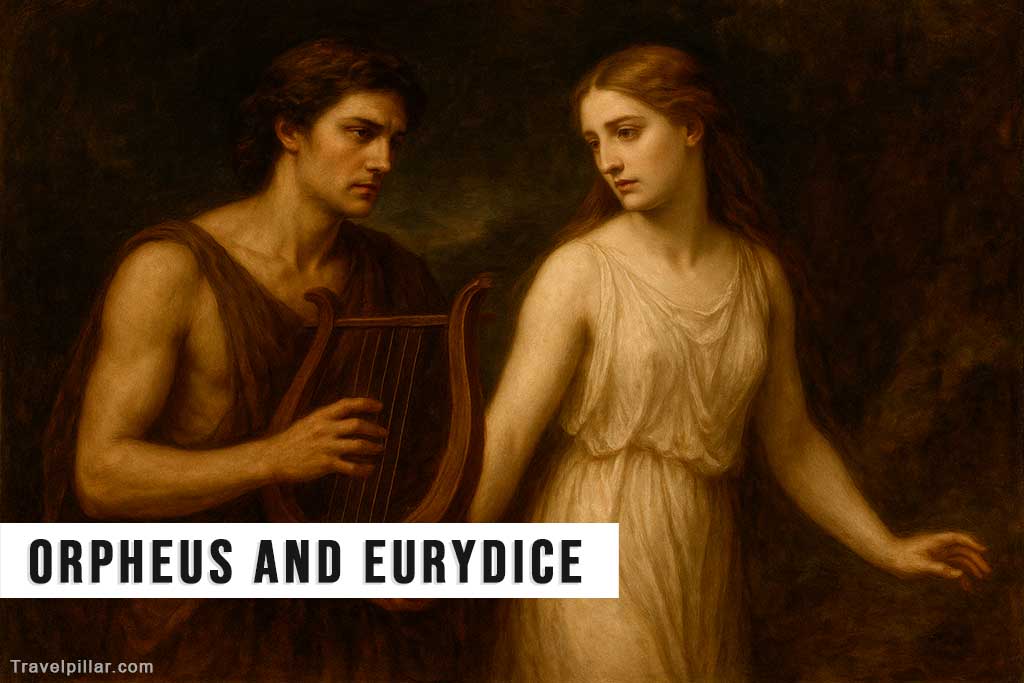
Orpheus, a legendary figure in Greek mythology, is renowned for his exceptional musical abilities and his tragic love story. He was the son of the Muse Calliope and either Apollo or the Thracian king Oeagrus, and he was famed throughout the ancient world for his skill with the lyre. Orpheus’ music was so powerful that it could charm animals, move inanimate objects, and even alter the course of natural events, such as calming rivers and taming the wild.
Orpheus’ most famous myth is his ill-fated love story with Eurydice. After their marriage, Eurydice tragically died from a snake bite, and Orpheus, grief-stricken, resolved to bring her back from the underworld. Using his enchanting music, he journeyed to the realm of Hades and Persephone, the rulers of the underworld. His playing moved them so deeply that they allowed him to bring Eurydice back to the world of the living on one condition: he must not look back at her until they had fully emerged from the underworld.
Orpheus accepted, but as they neared the surface, his anxiety overtook him, and he looked back at Eurydice. In that moment, she vanished forever, returning to the underworld. This tale is often interpreted as a reflection on the fragility of life and love, and it emphasizes the importance of trust and patience.
After Eurydice’s final loss, Orpheus lived in isolation, dedicating himself to his music. In one version of the myth, he was eventually killed by the Maenads, followers of Dionysus, who tore him apart in a frenzied rage. His head and lyre were said to have been thrown into the river Hebrus, where his music continued to echo.
Orpheus is closely associated with the development of mystery religions, particularly the Orphic Mysteries, which focused on themes of life, death, and rebirth. Travelers interested in Orpheus’ myth can visit regions of Thrace and ancient sites connected to the Orphic Mysteries, reflecting his enduring legacy as one of the most influential figures in Greek mythology.