
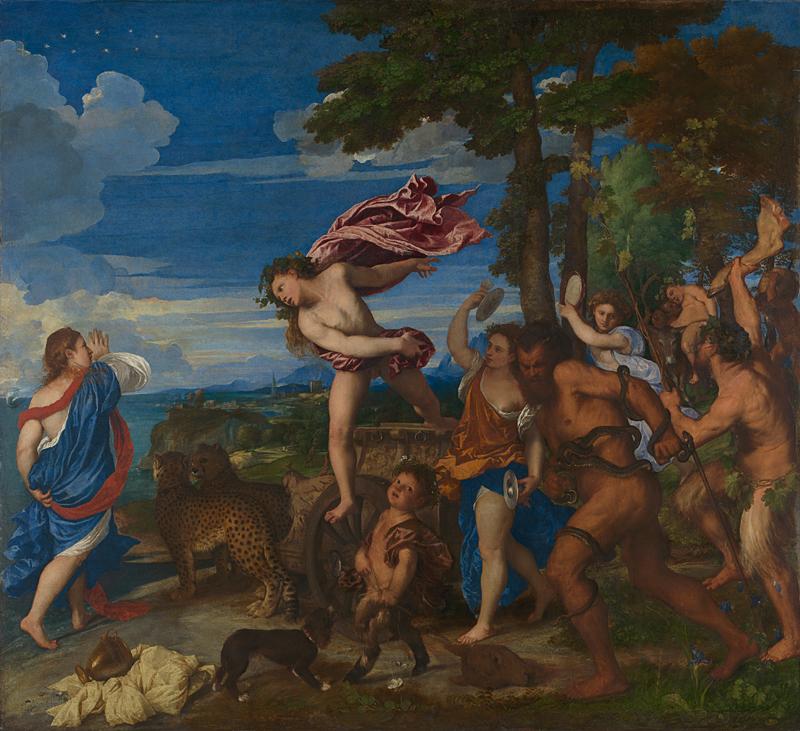
Bacchus and Ariadne was painted by Titian in 1522–1523 and is now in the National Gallery London. The painting illustrates a moment from classical mythology, when the god Bacchus (Dionysus) encounters Ariadne on the island of Naxos. The scene captures an instant of dramatic transition — abandonment followed immediately by rescue.
According to the myth, Ariadne had helped the hero Theseus escape the Labyrinth in Crete by giving him a thread to retrace his steps after killing the Minotaur. In return, Theseus promised to marry her. Instead, he abandoned her on Naxos while she slept. In the painting, Ariadne stands at the left, turning away from the departing ship of Theseus, visible in the distance. Her raised arm and tense posture convey shock and distress.
From the right bursts Bacchus, god of wine, ecstasy, and transformation. He leaps from his chariot, drawn by cheetahs, towards Ariadne. His movement is energetic and impulsive, contrasting with her isolation. In myth, Bacchus falls instantly in love with her and makes her his wife, offering not betrayal but devotion. He later places her golden crown in the sky as the constellation Corona Borealis, granting her a form of immortality.
Behind Bacchus follows his lively entourage of satyrs and maenads, figures associated with wild celebration and altered states. One satyr drags the severed head of a calf, while another plays cymbals, reinforcing the atmosphere of ritual and frenzy. These details emphasise Bacchus as a god of both pleasure and unpredictability.
The painting explores themes of loss, transformation, and renewal. Ariadne moves from despair to unexpected redemption within a single moment. Her story suggests that abandonment does not define destiny; new possibilities can emerge abruptly and dramatically.
For modern viewers, Bacchus and Ariadne remains compelling because it presents emotion in motion. Titian captures the precise second when grief gives way to change. The myth speaks to experiences of betrayal and recovery, reminding us that endings can lead to unforeseen beginnings. The painting balances human vulnerability with divine intervention, offering a narrative of sudden reversal that continues to resonate.
Weblink: https://www.nationalgallery.org.uk/