
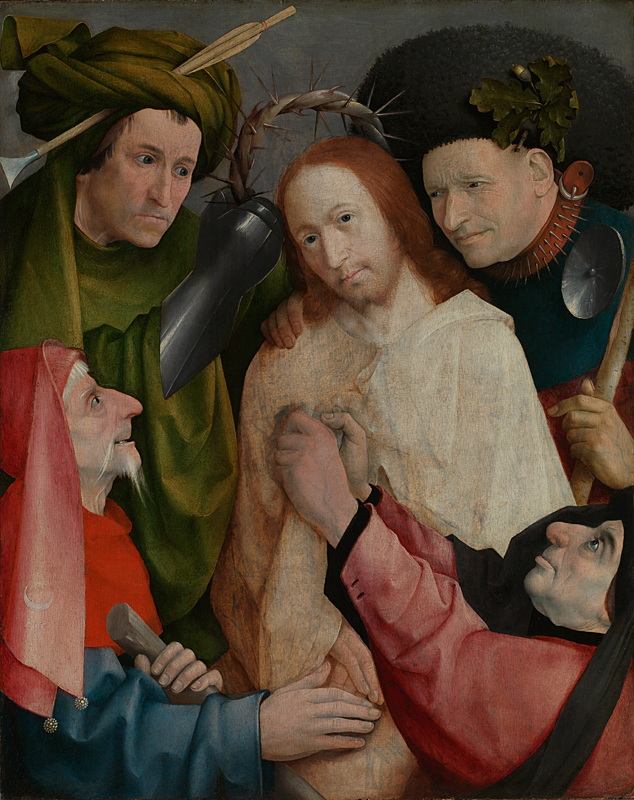
Christ Mocked (The Crowning with Thorns) was painted by Hieronymus Bosch around 1490–1500 and is now in the National Gallery London. The painting depicts the moment when Christ is humiliated before his Crucifixion. Rather than presenting a large crowd scene, Bosch compresses the drama into a tight cluster of faces surrounding Christ, creating an atmosphere of psychological pressure rather than physical spectacle.
At the centre stands Christ, calm and inward-looking. The crown of thorns already rests upon his head, symbolising both mock kingship and suffering. His hands are bound, and his expression is subdued and reflective. He does not resist or react dramatically. Instead, he appears composed, almost detached from the hostility around him.
Four tormentors press in closely. Their faces are sharply individualised, almost exaggerated. The man in green above Christ’s left shoulder grips a weapon and leans inward, intent and calculating. Opposite him, a soldier in armour watches with controlled menace. Below, a man in red and blue holds a wooden club, his expression tense and focused. On the lower right, another figure reaches toward Christ’s robe, crowding his space rather than striking him. The violence here is implied rather than graphically shown. The figures create an enclosing ring of hostility.
Bosch’s decision to eliminate background detail intensifies the confrontation. There is no landscape or architectural setting to distract the viewer. The composition forces attention onto faces and expressions. The aggressors’ features verge on caricature, suggesting moral distortion. They are not simply historical figures but embodiments of cruelty, pride, and blindness.
The crown of thorns reverses worldly expectations of power. Christ is mocked as a king, yet in Christian belief he represents spiritual authority. The surrounding men, confident and forceful, embody earthly dominance but appear morally diminished. The painting therefore becomes less about physical torment and more about character and conscience.
For modern viewers, Christ Mocked remains striking because of its intensity. The close grouping draws the viewer into the scene, almost as another witness. Bosch avoids theatrical spectacle and instead concentrates on moral character. The work suggests that cruelty often hides behind ordinary faces, while dignity can remain intact even under humiliation. The painting is less about historical detail and more about the enduring tension between violence and restraint, power and conscience.
weblink: https://www.nationalgallery.org.uk/