
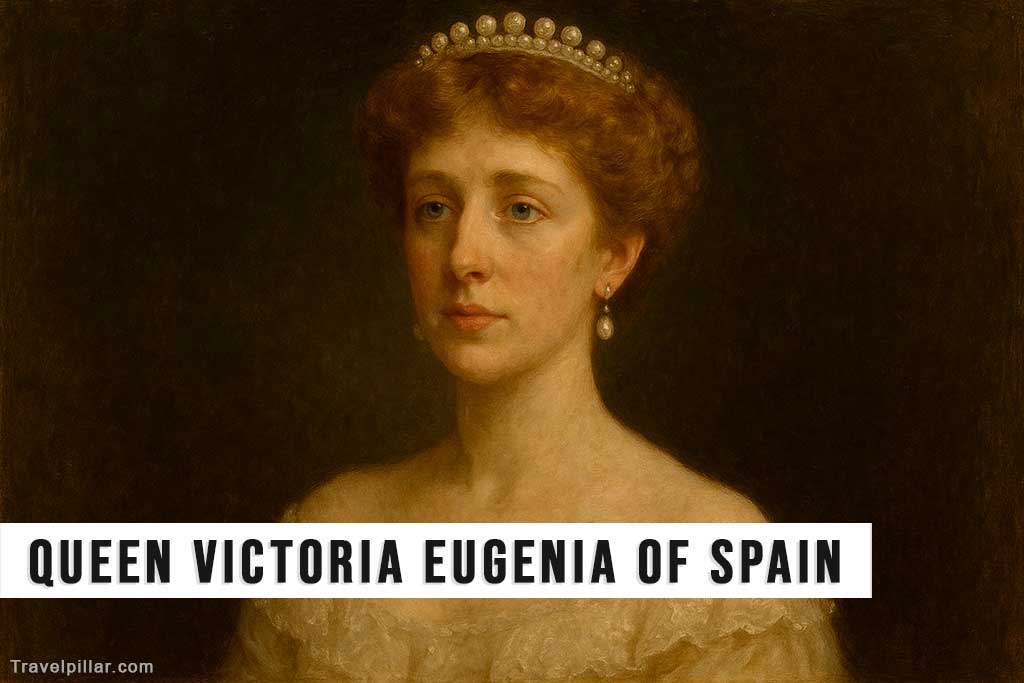
Queen Victoria Eugenia of Spain, or Victoria Eugenia Julia Ena, was born on October 24, 1887, in Balmoral Castle, Scotland, to Prince Henry of Battenberg and Princess Beatrice of the United Kingdom, the youngest daughter of Queen Victoria. She was thus a granddaughter of Queen Victoria of the United Kingdom, and, due to her mother’s marriage, she bore the title of Princess of Battenberg.
Victoria Eugenia married King Alfonso XIII of Spain on May 31, 1906. Their wedding was marked by a bombing incident by Catalan anarchists, an event that marked the political tension that would characterize her time as queen. She was the mother of seven children, including the future Don Juan de Borbón, father of King Juan Carlos.
One significant issue that Victoria Eugenia faced during her reign was the inheritance of hemophilia, a disease she carried unknowingly as a consequence of being a descendant of Queen Victoria, who had been a carrier of the disease. Two of her sons, Alfonso and Gonzalo, were affected, which caused family and political tension.
The tumultuous political climate of Spain during her time as queen, including the dictatorship of Primo de Rivera and the establishment of the Second Spanish Republic in 1931, led to the exile of the royal family. After her husband’s death in 1941, she lived primarily in Switzerland and Italy.
Following Franco’s death and the subsequent transition to democracy, she visited Spain several times. However, she was never entirely comfortable in the country due to her fraught relationship with her grandson, King Juan Carlos I, and his wife, Queen Sofía. Queen Victoria Eugenia passed away on April 15, 1969, in Lausanne, Switzerland.
Throughout her life, she was noted for her elegance and charity work, especially in health-related fields. Despite the adversities and controversies she faced, Queen Victoria Eugenia is an important figure in the history of Spanish royalty.