

Camposanto Monumentale, or the Monumental Cemetery, is a historically and architecturally significant structure located in Pisa, Italy, within the world-renowned Piazza dei Miracoli (Square of Miracles). Esteemed as one of the most beautiful cemeteries in the world, Camposanto represents an essential aspect of Pisa’s cultural and historical heritage.
The construction of Camposanto began in 1278 under the direction of architect Giovanni di Simone. The structure was erected around a sacred soil brought back from Golgotha during the Fourth Crusade, the site believed to be where Christ was crucified. Hence, Camposanto was historically a highly sought-after final resting place.
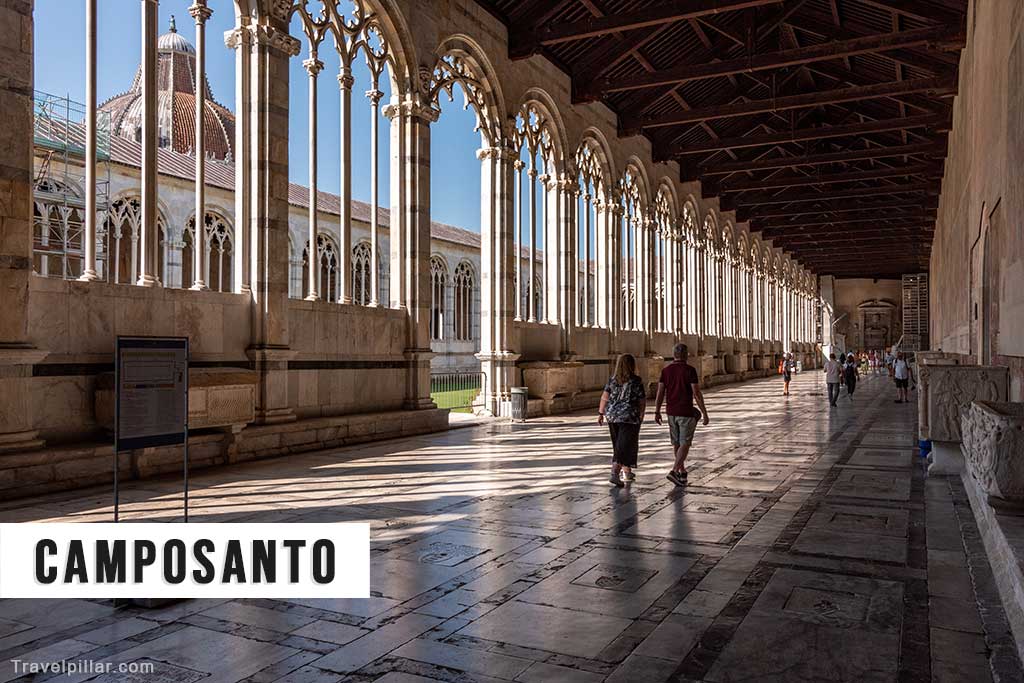
The structure features an oblong layout, and its outer wall is characterized by 43 blind arches, with two doorways located at the ends. Inside, Camposanto presents a quiet cloister, surrounded by Gothic arcades and an elegantly manicured central lawn, which creates an ambiance of serenity and reverence.
Camposanto’s interior walls were once adorned with an extensive collection of frescoes, which were severely damaged during World War II. Among the most significant of these frescoes was “The Triumph of Death,” attributed to Buonamico Buffalmacco. Post-war restorations have sought to recover and preserve these invaluable works of art.
The cemetery also houses a collection of Roman sarcophagi, which were reused during the Middle Ages for the burial of prominent citizens. These sarcophagi further illustrate the blending of classical and medieval art that characterizes much of Pisa’s architectural heritage.
In addition to its function as a cemetery, Camposanto is also home to two notable chapels: the Chapel Ammannati, built in the 16th century, and the Dal Pozzo chapel, added in the 19th century.
Today, Camposanto stands as an essential part of Pisa’s rich historical and cultural tapestry. Despite the ravages of time and war, it remains a symbol of the city’s medieval past and an exemplar of Gothic architecture.
Google map 4.6/5