
South America, the fourth largest continent in the world, offers travelers a rich tapestry of diverse cultures, landscapes, and experiences. From the ancient ruins of Machu Picchu in Peru to the vibrant streets of Rio de Janeiro in Brazil, South America is a continent of contrasts. Visitors can explore the Amazon Rainforest, trek through the Andes Mountains, or relax on the beaches of the Caribbean coast. With its rich history, natural beauty, and warm hospitality, South America beckons adventurers seeking unforgettable experiences.
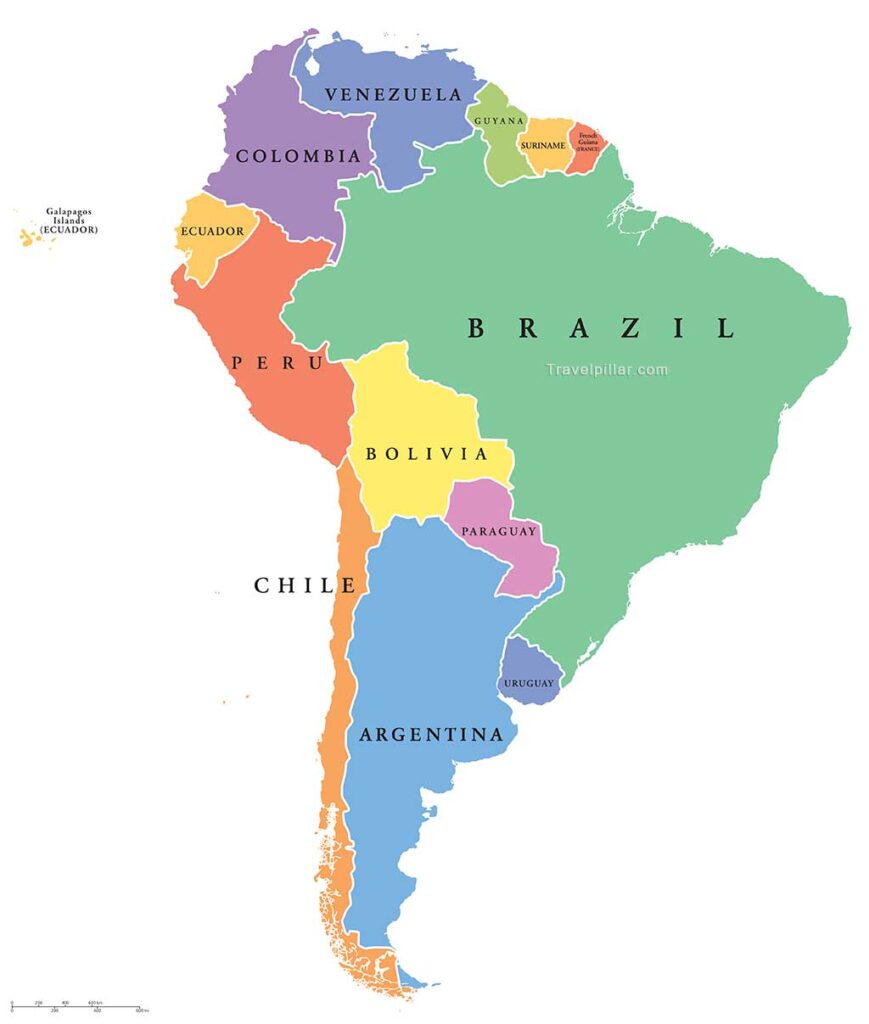
A list of South American countries ordered by the number of tourists received typically looks like this (from highest to lowest):
Brazil
Brazil is known for its diverse landscapes and cultural vibrancy. The Amazon rainforest is one of the world’s richest ecosystems, drawing visitors interested in biodiversity and river exploration. Rio de Janeiro is famous for landmarks such as Christ the Redeemer, Copacabana Beach, and the Sugarloaf Mountain, while São Paulo serves as a hub for business and contemporary culture. Carnival, Brazil’s most celebrated festival, combines music, dance, and elaborate parades, representing a major attraction for international tourism.
Argentina
Argentina attracts visitors with its combination of natural and cultural highlights. The Iguazu Falls, shared with Brazil, is one of the world’s most spectacular waterfalls. Patagonia, stretching southwards, offers glaciers, mountains, and unique wildlife. Buenos Aires, the capital, is known for tango, European-style architecture, and lively neighbourhoods such as San Telmo and La Boca. Mendoza, at the foot of the Andes, has become a leading wine region, particularly famous for Malbec.
Chile
Chile is recognised for its geographical contrasts, stretching from the Atacama Desert in the north to the glaciers of Patagonia in the south. Santiago, the capital, combines modern development with access to nearby vineyards and ski resorts in the Andes. The coastal city of Valparaíso, with its hills and colourful houses, has UNESCO status. Easter Island, with its moai statues, is one of the country’s most significant archaeological sites and attracts global interest.
Peru
Peru is renowned for its ancient Inca heritage and striking landscapes. Machu Picchu, a UNESCO World Heritage site, is the best-known attraction, often accessed via the Inca Trail. Cusco, once the Inca capital, preserves colonial and pre-Columbian architecture. The Sacred Valley and Lake Titicaca provide insight into Andean culture and traditions. Lima, the capital, combines colonial landmarks with a growing reputation for gastronomy, positioning Peru as a leading cultural and historical destination in South America.
Colombia
Colombia has re-emerged as a major travel destination with diverse offerings. Cartagena, on the Caribbean coast, is recognised for its walled old town and colonial architecture. The coffee region, particularly around Armenia and Manizales, is a centre of agricultural and cultural tourism. Medellín, once notorious, has transformed into a modern and innovative city. Colombia’s varied geography includes Caribbean beaches, Amazon rainforest, and Andean peaks, giving it a range of natural and cultural attractions.
Ecuador
Ecuador is notable for its natural variety within a relatively small area. The Galapagos Islands are internationally recognised for unique wildlife, studied extensively since Charles Darwin’s visit. The Andes cross the country, offering cities such as Quito, a UNESCO-listed colonial capital. The Amazon region provides opportunities for ecological tourism, while the Pacific coast has beaches and fishing communities. Ecuador’s location on the equator has shaped its identity and given the country its name.
Uruguay
Uruguay is one of South America’s smaller nations but has a stable tourism sector. Punta del Este is the most prominent resort, known for its beaches and modern atmosphere. The capital, Montevideo, combines a historic old town with a lively cultural scene. Colonia del Sacramento, a UNESCO World Heritage site, preserves colonial streets and architecture reflecting Portuguese and Spanish influence. Uruguay is also known for its relaxed lifestyle and traditional cuisine centred around beef.
Bolivia
Bolivia is a landlocked country distinguished by its dramatic highland landscapes and indigenous cultures. The Uyuni Salt Flats, the largest in the world, create striking reflections during the rainy season. Lake Titicaca, shared with Peru, is considered the highest navigable lake globally and has significant cultural history. La Paz, located at high altitude, offers markets and access to nearby mountains. Bolivia’s mix of Andean, Amazonian, and colonial heritage makes it a distinctive destination.
Paraguay
Paraguay is less visited than its neighbours but offers unique attractions. Asunción, the capital, combines colonial remnants with modern development. The Jesuit missions, such as Jesús and Trinidad, are UNESCO World Heritage sites showcasing Baroque architecture in a South American context. Natural areas include the Chaco region, known for wildlife and open plains. Paraguay’s culture reflects a strong blend of Spanish and Guaraní influences, evident in language, music, and traditional crafts.
Venezuela
Venezuela is geographically diverse, ranging from the Caribbean coast to the Andes and Amazon rainforest. Angel Falls, the world’s highest waterfall, is a major highlight within Canaima National Park. The Los Roques archipelago offers coral reefs and beaches, while Mérida provides access to the Andes. Despite recent challenges, the country remains known for its natural variety and striking landscapes, which have long established its reputation within South American tourism.
Guyana
Guyana is characterised by extensive rainforests, rivers, and waterfalls. Kaieteur Falls, considered one of the world’s most powerful waterfalls, is the country’s best-known natural landmark. Georgetown, the capital, displays colonial wooden architecture and a botanical garden. Guyana is less developed in terms of mass tourism, making it attractive to adventure travellers and those seeking ecotourism. Its cultural influences include African, Indian, and Amerindian heritage, reflected in festivals, cuisine, and daily life.
Suriname
Suriname is the smallest independent country in South America but holds cultural and ecological interest. Paramaribo, the capital, is recognised for its Dutch colonial wooden architecture and UNESCO World Heritage status. The interior is dominated by rainforest, providing opportunities for river trips and wildlife observation. Suriname’s population reflects African, Indian, Javanese, and Indigenous heritage, creating a multicultural society. The combination of natural and cultural features gives Suriname an individual position in the region.
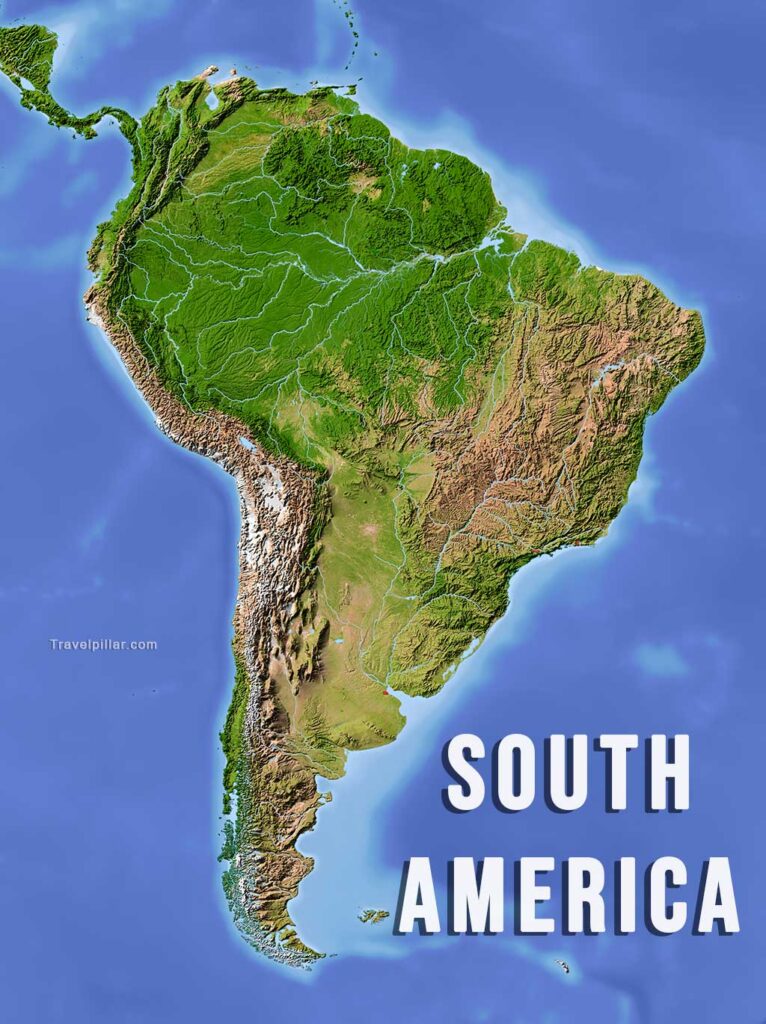
This is a physical map of South America, highlighting the continent’s topography and major geographical features. Here are some key features visible on this map:
Andes Mountains
The Andes Mountains run along the entire western edge of South America, stretching through seven countries from Venezuela in the north to Chile and Argentina in the south. They are the world’s longest continental mountain range and reach some of the highest altitudes outside the Himalayas. The Andes are home to varied climates, active volcanoes, and important archaeological sites, including remnants of the Inca civilisation, making them both a natural and cultural landmark.
Amazon Basin
The Amazon Basin dominates northern South America, covering large areas of Brazil, Peru, Colombia, and neighbouring countries. Centred on the Amazon River, the largest river system by discharge volume in the world, the basin contains the Amazon rainforest, often referred to as the planet’s “lungs.” This vast region is rich in biodiversity, supporting countless species of flora and fauna, and plays a critical role in regulating global climate and ecological systems.
Brazilian Highlands
The Brazilian Highlands occupy much of eastern and southeastern Brazil, forming a vast region of plateaus and mountain ranges. The area influences Brazil’s river systems, with many waterways originating here, including tributaries of the Amazon. It is also an important agricultural and economic zone, supporting coffee, cattle, and other industries. Major cities such as Brasília and Belo Horizonte lie within the highlands, highlighting their significance in Brazil’s geography and development.
Patagonia
Patagonia spans southern Argentina and Chile, defined by wide plains, deserts, fjords, and the southern Andes. The Argentine side is characterised by steppe landscapes, while the Chilean side contains glaciers, forests, and dramatic coastlines. Patagonia is sparsely populated but renowned for outdoor activities such as trekking, wildlife observation, and visits to natural parks. Its remote environment and rugged scenery have made it one of South America’s most distinctive geographical regions.
Gran Chaco
The Gran Chaco is a large alluvial plain stretching across parts of Argentina, Paraguay, Bolivia, and Brazil. It is characterised by subtropical forests, savannahs, and wetlands, with a hot climate and seasonal rainfall. Historically less developed than surrounding areas, it is sparsely populated but increasingly used for agriculture, particularly cattle ranching and soy cultivation. The Gran Chaco remains significant for its biodiversity and as a transitional region between different ecological zones.
Pampas
The Pampas are extensive fertile lowlands covering much of central Argentina and extending into Uruguay. Known for their flat grasslands and temperate climate, the Pampas are the agricultural heartland of Argentina, particularly associated with cattle ranching and grain production. The region has cultural importance as the home of the gaucho tradition, which shaped Argentine identity. Today, the Pampas remain one of South America’s most productive and recognisable rural landscapes.
Atacama Desert
The Atacama Desert, located in northern Chile, is one of the driest places on Earth, with some areas receiving little to no rainfall for centuries. The landscape is defined by salt flats, volcanoes, and unusual rock formations. Despite its arid conditions, it is rich in mineral resources, particularly copper and lithium. Astronomical observatories are located in the region due to its clear skies, making the Atacama both a scientific and geographic landmark.
Guiana Highlands
The Guiana Highlands cover parts of Venezuela, Guyana, Suriname, French Guiana, and northern Brazil. This plateau region is notable for its table-top mountains, known as tepuis, which rise sharply from the surrounding lowlands. Angel Falls, the world’s highest waterfall, cascades from one of these tepuis in Venezuela. The highlands contain extensive forests and diverse ecosystems, making them an important centre of biodiversity. They also hold cultural significance for Indigenous communities.
Orinoco River Basin
The Orinoco River Basin extends across Venezuela and Colombia, forming one of South America’s largest river systems. The Orinoco River stretches more than 2,000 kilometres, supporting extensive wetlands, savannahs, and forests. The basin provides vital resources for agriculture, hydroelectric power, and fishing, while also hosting rich biodiversity, including river dolphins and numerous bird species. The Orinoco’s role in trade and transport has made it an important feature in the region’s geography.
Pantanal
The Pantanal is one of the world’s largest tropical wetland areas, located primarily in western Brazil but extending into Bolivia and Paraguay. It is seasonally flooded, creating diverse habitats that support a wide range of wildlife, including jaguars, capybaras, caimans, and hundreds of bird species. The Pantanal is recognised as a key area for ecological tourism and conservation. Its rich biodiversity makes it one of South America’s most significant natural environments.
These geographical features play a significant role in the climate, biodiversity, and human activities in the region.