
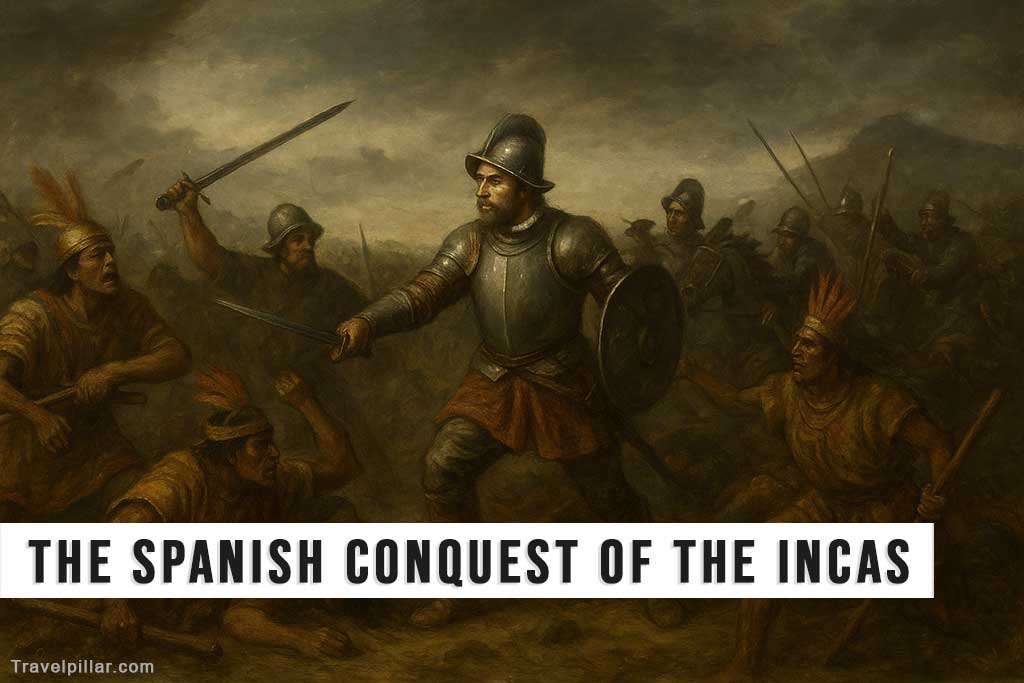
The Spanish conquest of the Inca Empire, often known as the Conquest of Peru, was one of the most important campaigns in the Spanish colonization of the Americas. It took place in the first half of the 16th century, led by Francisco Pizarro and his brothers.
Background
Francisco Pizarro, a Spanish conquistador, led the expedition to the Inca Empire. He was inspired by the success of Hernán Cortés, who had successfully conquered the Aztec Empire in Mexico. In 1532, Pizarro and his men arrived in the Inca Empire, just as it was recovering from a civil war between two brothers, Huáscar and Atahualpa, vying for the throne following the death of their father, the Sapa Inca (emperor) Huayna Capac.
Capture of Atahualpa
Pizarro and his men, estimated at around 170 soldiers, arrived in the city of Cajamarca where they requested a meeting with Atahualpa, who had recently won the civil war against his brother and consolidated power. Atahualpa agreed to meet with the Spanish, but the meeting turned out to be a trap. Despite being vastly outnumbered, the Spanish, armed with superior weapons including firearms and cannons, ambushed the Inca entourage. The surprise attack caused chaos among the Inca, and Atahualpa was captured, while thousands of his men were slaughtered.
Aftermath of the Capture
While held captive, Atahualpa offered to fill a large room with gold and silver as a ransom for his release. The Spanish agreed, and the Incas delivered the ransom. However, even after the ransom was paid, Pizarro went back on his word and had Atahualpa executed in 1533.
Conquest of the Inca Empire
With the death of Atahualpa, the Spanish installed a puppet ruler, Manco Inca Yupanqui, who was expected to rule on their behalf. However, Manco Inca rebelled against the Spanish and led the Inca resistance. Despite this, the Spanish continued their conquest, founding the city of Lima in 1535 as the new capital of the Spanish colony.
Resistance to Spanish rule continued for several more decades in the form of various rebellions. However, the Inca Empire could not regain its former power.
Impact
The conquest had a devastating effect on the indigenous population, with violence, exploitation, and disease significantly reducing their numbers. The Spanish established a colonial regime that lasted nearly three centuries, drastically changing the cultural, demographic, and economic landscape of the region.
The conquest also led to the looting of vast amounts of gold and silver, which were shipped to Spain and significantly altered the European economy. This wealth helped fuel the European Age of Exploration and the rise of Western Europe as a global power.
The Spanish conquest of the Inca Empire is a significant event in the history of the Americas, marking the end of one of the largest empires in the pre-Columbian New World and the beginning of Spanish hegemony in South America.