

Claude Monet (1840-1926) was a pioneering French painter and a leading figure in the Impressionist movement, which sought to capture the transient beauty of nature through the use of light, color, and innovative techniques. Born in Paris and raised in Le Havre, Monet’s artistic talents became evident from an early age. He studied under the guidance of several influential artists, including Charles Gleyre and Eugène Boudin, who introduced him to the practice of painting en plein air, or outdoors.
Monet’s groundbreaking approach to art involved applying short brushstrokes of pure, unmixed color to the canvas, creating a vibrant, textured surface that conveyed the changing atmosphere and mood of the scene. His work challenged the traditional academic style of painting, which focused on historical subjects and precise, detailed representations.
Some of Monet’s most iconic works include the “Water Lilies” series, inspired by the pond and gardens at his home in Giverny, and the “Rouen Cathedral Series,” which captured the facade of the Rouen Gothic cathedral under varying light conditions. His painting “Impression, Sunrise” (1872) gave the Impressionist movement its name and is considered a defining work of the genre.
Throughout his career, Claude Monet faced financial difficulties and critical resistance, but his perseverance and dedication to his artistic vision ultimately led to widespread recognition and acclaim. Today, Claude Monet’s paintings are celebrated for their innovative style, vivid colors, and enduring impact on the world of art. His contributions to the Impressionist movement have left an indelible mark on the history of art, inspiring countless artists and admirers for generations to come.
Claude Monet’s work can be found in numerous museums and galleries around the world. Some notable institutions that house his paintings include:
Musée d’Orsay, Paris, France
This museum has an extensive collection of Impressionist and Post-Impressionist artwork, including many of Monet’s masterpieces such as “Water Lilies,” “Rouen Cathedral,” and “Les Coquelicots (Poppy Field).”

Musée Marmottan Monet, Paris, France
This museum is dedicated to Monet’s work and houses the largest collection of his paintings, including some lesser-known pieces from his early career.
Musée de l’Orangerie, Paris, France
Located in the Jardin des Tuileries, this museum is famous for its two oval rooms that showcase Monet’s monumental “Water Lilies” murals. The museum also houses other Impressionist and Post-Impressionist paintings.
The National Gallery, London, UK
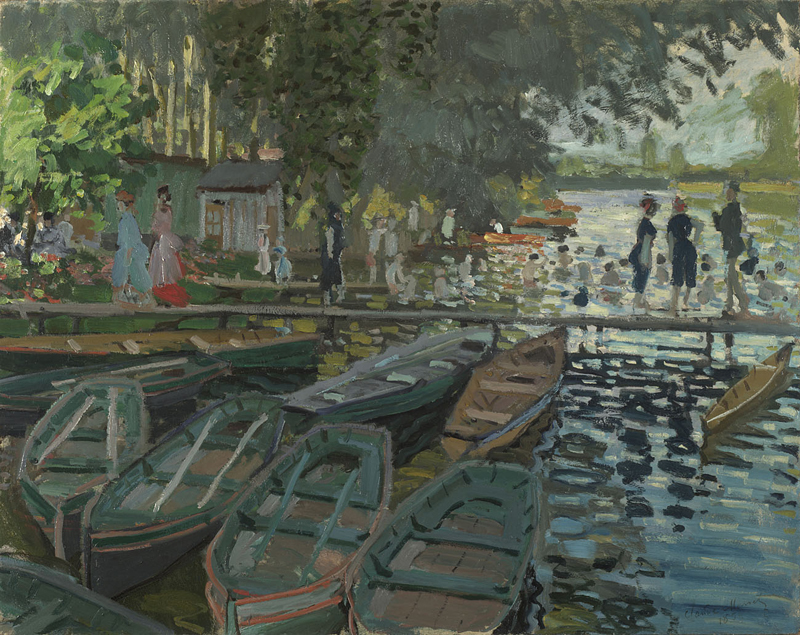
The gallery features several of Monet’s works, such as “Water-Lily Pond” and “Bathers at La Grenouillère.”


The Art Institute of Chicago, Chicago, USA
This museum holds a significant collection of Monet’s paintings, including six from the “Haystacks” series and several “Water Lilies” canvases.
The Museum of Modern Art (MoMA), New York, USA
MoMA’s collection includes Monet’s “Water Lilies” and “Reflections of Clouds on the Water-Lily Pond.”
The Metropolitan Museum of Art, New York, USA
The Met has a number of Monet’s works in its collection, such as “The Path through the Irises” and “Regatta at Sainte-Adresse.”
The National Gallery of Art, Washington D.C., USA
This gallery features several Monet paintings, including “The Japanese Footbridge” and “Woman with a Parasol.”